Thursday, April 28, 2011

Intellectual Property and Indigenous Innovation, Two Opposite Roads For Foreign IPR Holders

Photo Danny Friedmann
IP and indigenous innnovation
roads going in opposite directions?
The US-China Economic and Security Review Commission will hold hearings on China's intellectual property  and indigenous innovation policies on May 4th. Emphasis will be given on the consequences of these policies for the film, broadcast, and software industries.

Programme:
8:30 am – 8:45 am: Hearing Co-Chairs’ Opening (Commissioners Dick D’Amato and Dennis Shea);
8:45 am – 9:15 am: Panel I: Congressional Perspectives by Senator Slade Gorton (R-WA) - retired;
9:15 am – 10:45 am: Panel II: Film and Broadcast Industry by Mr. Richard Masur, former President, Screen Actors Guild;
11:00 am – 12:30 pm: Panel III: Business Software by Mr. Michael Schlesinger, Of Counsel, Greenberg
Traurig, and International Intellectual Property Alliance and Mr. Ken Wasch, President, Software & Information Industry Association;

1:15 pm – 2:30 pm: Panel IV: China’s Indigenous Innovation Policy by Ms. Thea Lee, Deputy Chief of Staff, AFL-CIO and Mr. Alan Wm. Wolff, Of Counsel, Dewey & LeBoeu.

Information about location here.

Tuesday, April 26, 2011

The Process of Trademark Counterfeiting Captured

How An External DVD Drive Becomes A Counterfeit Apple in 5 Minutes

Dong Men (东门= East Gate) in Shenzhen is an incredible place. You can find buildings with small shops that all sell one component of a mobile phone or computer per floor, and on the next floor another component. On Shennan Central Road there is such a building named 华 Hua 强 Qiang (China Strong) 电 Dian 子 Zi (Electronic) 世 Shi 界 Jie (World) where you can buy external DVD drives.
In this photo series the whole procedure of counterfeiting is captured.

On Shennan Central Road there is a building
where you can find external DVD drives. 

Up the elevator you can see a red banner with yellow characters:
"Severe prosecution will be engaged against those selling counterfeited products illegally"

Here is the empty red casing


Then a sticker with the Apple logo came out of a drawer.

Adhesive plastic removed.

Sticker was placed


And ready is the counterfeit Apple DVD drive.

Just outside of the building is an official Apple dealer
Apple does not make any external DVD drives, to my knowledge. The counterfeit DVD drive, play only, no burning is possible, was on offer for 150 RMB, which is a little bit less than 23 US dollar.

Happy World Intellectual Property Day 2011!

Sunday, April 24, 2011

Forgive Them For They Know Not What They Do. Now Do They?

God has strange lodgers
Nick Squires reports for The Telegraph that 13 million pounds worth of counterfeit souvenirs was seized before the beautification of the late pope John Paul II.

The products involved were ""family packs" of plastic rosaries which they said could be dangerous because they did not pass European safety standards."

The assumption is that the counterfeit goods originate from China: "The goods are believed to have been shipped from China to a port in northern Europe and then transported to Italy in trucks." Read Squires article here.

Catholic News USA wrote: 
"The 5.5 million items seized – which included fake Rolex, Omega and Cartier watches as well as pirate Mont Blanc pens – had a market value of around 15 million euros (S$26.9 million), it said according to an AFP report." Read here.

Another problem was that some people started to sell tickets to the beautification: "A further problem is reported by the Prefecture of the Papal Household, informed of the existence of "improper deals”, particularly via the internet, of services and tickets for payment The Household points out that there is no need of tickets to attend the ceremonies for the beatification. In addition, tickets granted by the Prefecture of the Pontifical Household, at pontifical ceremonies or general audiences, are always free, and no person or institution can demand any payment." Read more here.

Last year the Vatican denounced the deaths of 700,000 people because of counterfeit drugs. See here.

If the counterfeiters wrestle with their conscience they cannot use the iPhone app "Confessions" to get forgiveness according to the Vatican, read here.

Saturday, April 23, 2011

Copyright Piracy of Communist Books is Not Patriotic

Photo Danny Friedmann
"A book is like a garden that you can put into your pocket"

IP Dragon Weekend Edition

As the Chinese proverb goes "a book is like a garden that you can put in your pocket." However, you cannot multiply books just as plants (well not in the case of genetically modified plants), even though the government might find the books commendable.

The General Administration of Press and Publication (GAPP) said that the authorities have seized 27 suspects so far for pirating a book on the history of the Communist Party of China (CPC), Mu Xuequan writes for Xinhua. Eight publishers and binderies were closed in Sanhe City, in Hebei.
Mu writes: "Five officials also received punishments for dereliction of duty".

The book that was counterfeited was the second book in the series about the crucial period 1949-1978 period. From the founding of the People's Republic of China by Mao Zedong until the economic reforms and opening up to the world policy of Deng Xiaoping.

The GAPP tries now to fight copyright piracy by launching the Green Bookmark campaign "aimed to persuade the public to buy authorized publications." But how can one avoid that the copyright pirates copy the Green Bookmark too?

Read the Xinhua article here.

Friday, April 22, 2011

Double Dragon Head: Looking Backward, Looking Forward

Photo Mountain
Warren states, Shanghai Museum
Some rights reserved
Double headed dragon,
looking backward
looking forward
Looking backward:

星期一 Another mass anti-IP infringement campaign with a fancy name, here.
星期二 Oxford University professor about brandscape in China patient, but everything can go wrong, here. Some illustrations of the things that go wrong in Hong Kong, Micky copyright piracy, here and Polo/Burberry clone here.
星期三 Hangover from counterfeit liquor and wine, here.
星期四 IP Bank in Taiwan and China here, Shanghai Disneyland Shrouded in Secrecy, here.
星期五 Pfizer Is Moving R&D to China After History of IP Challenges here, Judicial interpretation for contributory liability is getting drafted here, TGIF: Magical-realist authorises publication in China here.

Looking forward:

IP Dragon Weekend Edition
星期六 If you love the Party, don't buy counterfeit communist books.
星期日 For the Sunday: Chinese counterfeit products "desecrate" the Vatican.

The Week Ahead (April 25-29)

星期一 Optimist/Negative Views Indigenous Innovation.
星期二 April 26th, China Cares About World IP Day, Does It Care About IP Enforcement Too?; Mobile Phonies.
星期三 "Clever, charming and charismatic man": biggest UK counterfeit importer from China; Too soft on software piracy? 
星期四 Ford Trade Secret Infringer Sentenced.
星期五 China's TV Format Business Starting To Respect IP?; Tiffany sues Four Chinese jewellery sellers for counterfeiting.

After 44 Years Chinese Lovers of Literature Can Legally Buy "One Hundred Years Of Solitude"

Photo Festival Internacional de Cine en Guadalajara 
TGIF

Zhang Lei wrote a nice article for the Global Times about Thinkingdomhouse, a publisher who achieved to get a copyright license for China from Nobel Prize for Literature laureate Gabriel García Márquez to publish his masterpiece 'One hundred years of solitude' (Cien años de soledad).

"Unauthorized editions were widely available in markets as early as the 1980s, which infuriated the author, who vowed that even 150 years after his death, his works would not be authorized in China, when he visited in 1990." Well if Márquez was quoted correctly, he might be able to abstain Chinese publishers from authorised versions, but his copyright will expire 50 years after the moment he will exchange the temporary with the eternal. Then again within magic-realism, a writing style Márquez brought to great fruition, 150 years starting in the 1980s is a possibility which can not be completely excluded. It is great news that this summer an authorised version of Márquez' masterwork will be on sale in China. On the one hand it is moral rights of the author to determine whether he makes his work public or not (le droit de divulgation). On the other hand you cannot blame Chinese literature lovers that they want to read Márquez' masterpiece of which Pulitzer Prize winner William Kennedy said "the first piece of literature since the Book of Genesis that should be required reading for the entire human race."

Zhang is mentioning China's membership of the Universal Copyright Convention in 1992, as the moment the publishing industry has gradually increased awareness of copyright. According to this convention an author had to put a © on their work, his name and the year of creation in order to be protected via copyright.

Article III (1.) Universal Copyright Convention: "Any Contracting 'State which, under its domestic law, requires as a condition of copyright, compliance with formalities such as deposit, registration, notice, notarial certificates, payment of fees or manufacture or publication in that Contracting State, shall regard these requirements as satisfied with respect to all works protected in accordance with this Convention and first published outside its territory and the author of which is not one of its nationals, if from the time of the first publication all the copies of the work published with the authority of the author or other copyright proprietor bear the symbol © accompanied by the name of the copyright proprietor and the year of first publication placed in such manner and location as to give reasonable notice of claim of copyright."

Interestingly, this is in contradiction to the "no formalities" requirement of article 5 (2) Berne Convention for the Protection of Literary and Artistic Works to which China acceded in the same year. UNESCO's Universal Copyright Convention has been rather dormant lately, but it could already make a useful distinction between works in the public domain without the © and those protected by copyright. It avoids also to some extent the copyright orphan problem, because the name must be included. Creative Commons has been "ported" to China and makes clear what kind of use is allowed online, see here

Read the Global Times article here.    

China's Supreme People's Court Will Tell You How Safe Safe Harbours Are

Photo Rneches
Main entrance Supreme People's Court Beijing
The writers versus Baidu case triggered the Supreme People's Court to draft a judicial interpretation of online copyright, and can be expected this year. A refinement of the Regulation on Protection to Network Dissemination of Information, is welcomed. Hopefully the Supreme People's Court will succeed in making the principles crystal clear whether a safe harbour applies or an online service provider is held contributorily liable. The president of the Supreme People's Court, Kong Xiangjun was quoted by Li Mao saying:  "The judicial interpretation would help protect copyright owners, network service providers as well as online users [..]." Judge Kong also said that half of all copyright cases were online cases. I hope they also illuminate the subject of online trademark, which sometimes is interpreted analogously with online copyright, but, given is distinct character, deserves its own attention from China's highest authority in the interpretation of the law.

Read Li Mao's article for the Global Times here.

Pfizer Starts R&D in China After IPR in China Challenges

Photo Danny Friedmann
Perilous hills, but nice view.
Climb worth the risk?
As one of the first U.S. companies pharmaceutical giant Pfizer has decided to start doing R&D in China. This way the company can probably take advantage of indigenous innovation preferential rules if it invents and patents in China. Read here.

Pfizer had some IP challenges in China. To brush up your memory, here is a summary of how Pfizer bot back its Viagra patent:
  • September 19, 2001 SIPO granted a patent for Viagra's active ingredient;
  • A dozen Chinese pharmaceutical companies file a petition to invalidate the patent, alledging that it failed adequate disclosure under article 26 Patent Law (at the time Patent Law 2000) and lacked novelty as required by article 22 Patent Law (at the time Patent Law 2000);
  • July 7, 2004 Patent Reexamination Board invalidated Pfizer's Viagra patent because it failed to meet the disclosure requirement;
  • September 28, 2004, Pfizer appealed the Patent Reexamination Board's decision at the Beijing No. 1 Intermediate People's Court;
  • June 2006 Beijing No. 1 Intermediate People's Court reversed the invalidation and remanded the case to SIPO for further determinations;
  • The Chinese pharmaceutical companies appealed to the Beijing High People's Court;
  • September 7, 2007 Beijing High People's Court upheld the Beijing No. 1 Intermediate People's Court.

Thursday, April 21, 2011

The Lay-Out of the Magic Kingdom in Shanghai Wrapped Up in a Trade Secret

"One rat will invite his friend"
In November 2009 the Chinese government approved that Shanghai would get its own Disneyland and even the first Disney resort in China. Hong Kong was not amused, because as of 2016 Hong Kong will no longer be the exclusive gate to the Magic Kingdom in China. Brady MacDonald wrote for the Los Angeles Times the reasons why the lay-out of the Shanghai Disneyland is shrouded in secrecy:

  • "To prevent knockoff rides by rival Asian theme parks, which happened before Hong Kong Disneyland's 2005 opening. 
  • To preserve creative flexibility for Disney's Imagineers during the ongoing "Blue Sky" development phase, when rides, shows and even entire lands appear or disappear.
  • To tread lightly with the Chinese government during the upcoming five-year engagement, which follows a delicate two-decade courtship."
Major construction of Shanghai Disneyland is expected to begin next month (May 2011), then it will become harder to keep the trade secret. 
Read more here.

Intellectual Property Bank in Taiwan and China (But Very Different)

Public sector
The China Post reports that the Ministry of Economic Affairs is setting up an IP bank: “The intellectual property bank is scheduled to be set up in June under the supervision of Taiwan's semi-official Industrial Technology Research Institute (ITRI). The bank will provide “protective shield” for Taiwan-based firms, especially those in the areas of renewable energy, green energy, mobile communications, LED, and flat panel manufacturing, by building patent portfolios and providing legal advice, the MOEA said.” Read here.

銀行

Private sector
Then an initiative from the private sector in China: Zhongtian Technology Company, set up an “IP bank” too. If I understand correctly it is a repository for patents and the patentees get some points from the bank, “the score and calculation method are linked with the contribution in principle”. “Items that can cash in rewards from the bank include new product results, new technological achievements and soft science achievements that are completed by employees or teams company resources or platforms, or with the help of research institutes, as well as various rationalization proposals.” Read here.
银行
Both pairs of characters mean "bank" (literally the first character means "silver" and the second "business"). 銀行 (yin2 xing2) is the traditional version, which they use in Taiwan and Hong Kong (only there it is pronounced as "nan4 hong4") and  银行 (yin2 xing2) is the simplified version which they use is the People's Republic of China and Singapore. The difference is indeed in the left character in the metal part. The numbers refer to the pronunciation: "2" means that the tone is going up. "4" means that the tone is going down.

Wednesday, April 20, 2011

On Counterfeit liquor and wine

People's Republic of China
During the massive IP enforcement campaign “Bright Sword” police cracked down in Beijing, Jiangsu, Zhejiang and Guizhou in 40 cases involving the production and selling of fake alcohol. China Daily wrote: “March 23 to 25, police raided 272 production and sales outlets nationwide and found more than 300 devices used for counterfeiting as well as over 13.5 million pieces of forged packaging materials, such as bottle caps, labels and boxes of well-known brands. Meanwhile, more than 30 tons of bulk wines and 13.5 million fake bottles, caps and labels worth up to 2 billion yuan (US$ 306 million) were also seized by police.” Read here.

Hong Kong
Special Administrative
Region
It is estimated that five percent of all wines in China are counterfeit. Is Chateau Le Tromperie on sale, instead of the label that is on the bottle? According to an article by Alexandra Lages for the Macau Daily Times: “Hong Kong’s expert Simon Tam recently alerted that the HKSAR newly-gained reputation as the wine-trading hub must be protected against fakes in the market. Tam said that the problem is not serious yet, but urged authorities to act fast.

Macau
Special Administrative
Region
In China, Hong Kong and Macau wine drinking has only recently become en vogue. Thus not everybody has the knowledge yet of what taste a certain wine should have. If it smells like paint remover it is clear, but the difference between a bulk wine and some special wine can be more subtle. And it is well known that it is near impossible to find out before buying some vintage wine whether the bottle is real but its content might be not. There is a luctrative trade in real bottles. As Peter Shadbolt points out Chateau Lafite bottles can fetch 1,500 US dollar on the black market in China. He quotes Fongyee Walker, a Beijing-based wine consultant with Dragon Phoenix Fine Wines. Ms Walker makes it clear that gifting is bad for a brand. Because if someone receives a counterfeit wine as a gift and recognises it as a counterfeit, chances are that he or she in turn will give it to someone as a gift, etc. See here.

(Chateau La Tromperie= Castle The Deception)

Read Ms Lages article here.

Tuesday, April 19, 2011

Why Could Polo Ralph Lauren/Burberry Clone Get Trademark In Hong Kong?

The outdoor advertisement of Polo Santa Roberta no longer has the
Burberry tartan pattern background

"Buy one get one free"
Is this what luxury goods manufacturers such as
Polo Ralph Lauren and Burberry want to be associated with? 

Here you can see the ® of registered trademark on the promotional poster

Still Polo Santa Roberta bags use Burberry-like tartan patterns
Polo Santa Roberta shop seen yesterday in Mongkok, Hong Kong. Remember my January 2011 posting when I thought that these kinds of shops were closed in Hong Kong, see here.

Polo Santa Roberta uses the ® of registered trademark in their promotional material. After checking the database of the Intellectual Property Department of Hong Kong, see here, they indeed have registered their brand (which is in my eyes controversial). 

The Polo/Lauren company registered (actual registration) its logo with the polo player with a stick high in the air in combination with the words 'Polo' and trademarks in July 12, 1994 in class 25 and July 17, 1996 in class 42. In February 2, 1999 was the actual registration of the word mark Polo for class 25. 

Santa Roberta Polo & Racoquet Club (owned by Hampton, Winter and Glynn), actual registration for class 25 on January 27, 2006. stick low. See the spelling of Racoquet. 
Polo Santa Roberta (owned by Santa Roberta Polo & Racquet Club International Limited), actual registration for classes 3 and 25 July 7, 2009, stick high in the air. 

I am interested to know why the Trade Mark Registry of the Hong Kong Intellectual Property Department did not refuse the registration of Polo Santa Roberta based on article 12 (3) Trade Marks Ordinance: 

"A trade mark shall not be registered if -
(a) the trade mark is similar to an earlier trade mark;
(b) the goods or services for which the application for registration is made are identical or similar to those for which the earlier trade mark is protected; and 
(c) the use of the trade mark in relation to those goods or services is likely to cause confusion on the part of the public.

Not only The Polo/ Lauren company's trademark is harmed, but the registered designs of Burberry tartan patterns as wel

Polo Santa Roberta shirts are no longer sold at the Ladies Market (女人街) in Mongkok. Instead "Polo" shirts are sold.
Polo shirts with the iconic Polo player logo
 at sale at Ladies Market (女人街), Mongkok, Hong Kong
One "Polo" shirt for 45 Hong Kong dollar (a little over 4 euro),
three for 120 Hong Kong dollar (almost 11 euro)
During the Tang dynasty, early 8th century CE, polo was a popular sport
This figurine can be found at Musée Guimet in Paris 

Mickey Mouse Went To the Ladies' Market in Hong Kong Without Disney Knowing It

Unauthorised Use of Disney's copyright 
Smoothite versus Samsonite

Emergent brandscape in China: “Sony was not built in a day”

David Barboza interviewed Karl Gerth who teaches modern Chinese history at Oxford University about his new book 'As China Goes So Does The World'. Professor Gerth is optimistic about Chinese brands. His take is that China will get strong brands indigenously or it will acquire foreign brands. We just have to give it some time: Professor Gerth: “Sony was not built in a day.

However, on an ominous note professor Gerth said about IPR protection and enforcement in China: “Rather than China increasingly protecting the intellectual property like the brand integrity of multinationals, perhaps counterfeits manufactured in China and exported globally will undermine global brands and consumerism itself. This is happening. Even as retailing and branding have been encouraging much more consumption in China, consumer confidence (both nationally and internationally) has been undermined by the massive production of Chinese counterfeits.

Read Mr Barboza's interview for the New York Times here.

Monday, April 18, 2011

How bright is Bright Sword?

Is the Force with mass campaigns?
Are mass campaigns of intellectual property enforcement mere temporary patchwork, leaving untouched the underlaying problems? Most mass campaigns are still announced with starting date and expiration date. The only thing trademark counterfeiters and copyright pirates need to do is book a holiday and start after the campaign is over, reinvigorated. Now I exaggerate a bit. But mass campaigns are in my view suboptimal and overrated, despite all the impressive statistics, and to be consumed by foreign media tired about reporting on IPR infringement cases in China.

The newest campaign is named Bright Sword. The question is whether it is a bit less typical in that it will continue for quite a long time. It started November 2010 and will continue until the end of 2011. The police seized 14,185 suspects in five months, allegedly involved in over 8,000 cases of IPR infringements, according to the Public Security Ministry.

Zhang Yan and Cai Yin wrote for the China Daily that Bright Swords focuses on eight fields including fake international brands, fake food and drugs, pirated film and television works as well as organised crime. Zhang and Cai wrote in the same article that the police is targeting four activities: agriculture, fake drugs, counterfeit wine and food, as well as fake brands. If the journalists are so unclear about which categories are targeted IPR infringers have a more difficult job finding out if they need to temporarily stop their activities.

Deputy director of the ministry's economic crime investigation department, Gao Feng was quoted saying that of 7,000 production and sales outlets were shut down and that the ministry will focus on the supervision of 340 major cases to ensure thorough investigation and punishment of violators. This information is a bit cryptical: does it mean that out of 8,000 cases just 340 cases are prosecuted?

Read the China Daily article here.

Sunday, April 17, 2011

Sunday Specialty: SARFT Knows Watching Time-travelling Is Bad

Photo Danny Friedmann
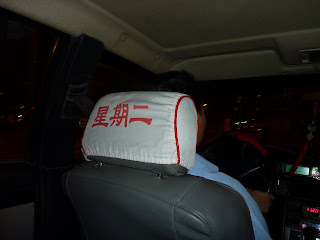
星期日 = Sunday: Time-travelling not allowed. Not even by taxi.
The State Administration for Radio Film and TV (SARFT) came up with the Notice Concerning the Nationwide Television Drama Shooting Filing Announcement for March 2011.

"In the recent few months, the general situation of reporting and filing of programmes nationwide is good, but we have also discovered some incorrect creation sprouting: individual supernatural dramas and time-travel dramas reported for filing, have compiled myths as they please, the plots are strange and bizarre, techniques are absurd, and they even play up feudal superstition, determinism, samsara and reincarnation, value orientations are ambiguous, and they lack a positive ideological sense."
SARFT knows what content "lacks a positive ideological sense" and what "value orientations are ambiguous". No more watching 'Back to the Future'. Now I am also becoming curious about SARFT's take on the positive ideological way we best should watch drama. Is time-shifting ok? Read SARFT's complete notice on Rogier Creemers' excellent China Copyright and Media here.

Time-travelling cannot completely excluded theoretically, at least according to Tom Weiler and Chui Man Ho. These physicists think that the Large Hadron Collider could be sending matter back in time. Read Science Daily of March 16, here.

Saturday, April 16, 2011

Saturated Saturday: Tsingtao Beer China's Well Known Trademark


Since September 20, 1991, Tsingtao Beer 青島啤酒 has been recognised as a well-known trademark in China. It was approved this status by the State Administration for Industry and Commerce (SAIC) during the first batch of China's Well-known Trademarks. Wang Jun, of Deheng Law Firm has a nice overview of the dual track system of well-known trademarks, see on China IP here.

This means that if Tsingtao Beer did not register its trademark it would still be able to stop other people of using the brand name for the same product category (beer). If they registered the well-known trademark, which they did, they canalso protect the trademarked brand against use in all product categories (even unrelated to beer).

More about the fundamentals of well-known trademarks see here:

Friday, April 15, 2011

Peter K. Yu Kicks Off the UNH Franklin Pierce Center for IP Distinguished Speaker in IP Lecture Series

Mary Wong, the first director of the University of New Hampshire Franklin Pierce Center for IP invited Drake University professor Peter K. Yu to give the inaugural speech of the Franklin Pierce Center for IP Distinguished  Speaker in IP Lecture Series, April 14, 2011.

Professor Yu gives a grand tour of IP enforcement, and recommends a holistic solution to get a more enabling environment. In regard to new international enforcement treaties such as ACTA, Professor Yu asserts that countries such as China, India and Brazil should be included.
Thank you Danielle Barrick for the link.

 
Video streaming by Ustream

Sino-U.S. Investment Treaty: A Little BIT For You and Me

Photo "Shaking Hands" by Nicola Corboy (Some rights reserved)

In May, 2011, the U.S.-China Strategic and Economic Dialogue will be resumed in Washington. Daniel Michaeli, research associate at the Council on Foreign Relations, a think tank and publisher, opines in the Huffington Post that the U.S. should negotiate a bilateral investment treaty (BIT) with China: “China has already signed 120 investment treaties around the world, including with Japan, Germany and the United Kingdom. The most recent ones have clauses providing foreign investors with the option to resort to binding international arbitration for intellectual property disputes, if Chinese local courts cannot resolve such issues satisfactorily (as, indeed, too often they cannot).

According to Mr Michaeli jobs do not necessarily follow U.S. investments to China: “Recent data indicates that U.S.-based multinational corporations locate more than half of their employees in the United States, where they have 70 percent of their operations and spend 87 percent of their research and development budget.

Read Mr Michaeli's article here.

Thursday, April 14, 2011

The Influence of China's Trade deficit on IP Enforcement in China

Light at the end?
Photo: Danny Friedmann

Remember that in 2009, because of the financial crisis, the Supreme People's Court urged the lower courts to conservatively grant injunctions, read here. Now too, there are economic circumstances that might not be conducive to the enforcement of IPRs in China. For the first time in seven years China has a trade deficit. China has a huge trade surplus with the U.S. and Europe, but a trade deficit with countries such as Saudi Arabia and Australia, because they import so many commodities. Since commodity rich countries can only absorb so many Chinese export products, chances are that China will try to compensate its trade deficit with countries it already has a trade surplus, such as the U.S. and Europe. Therefore it might not be willing to import more trademarked, patented and copyrighted goods from the U.S. and Europe, which could stimulate a demand for counterfeit and pirated goods. Read more here

Wednesday, April 13, 2011

50 percent Nike 50 percent Li-Ning, 0 percent Creativity...What percentage confusion?

Photo: Danny Friedmann
Seen today in hypermarket Carrefour, Futian, Shenzhen
Name of the brand: Fujian Jinjiang Hengren Shoes 

What Came First? Fake Chicken or Fake Egg

In 2008 I wrote a column for a Dutch magazine in which I assert that even people who do not want to do business in China or have no interest in IP at all, should take an interest in it, since IP in China will find you. Wherever you are. To map this process I started in April 2009 with IP Dragon's Worldwide Review of Seizures and Measures Against Counterfeit and Pirated Goods Originated From China. The Worldwide Review is regularly updated, latest for example about Matryoshkas made in China.

Last week IP Dragon was giving a presentation about the differences between IP in Hong Kong and China to the students of the University of Amsterdam's Institute of Information Law who were on an IP excursion to the Special Economic Region. The Amsterdam students' imagination could not entail the fact that eggs are counterfeited in China (and Malaysia). Earlier I wrote about fake egg school, where they teach migrants to the big cities how to manufacture fake eggs: 'You Cannot Buy A Real Egg in China Without Breaking It'. These eggs could severely harm someone's health. The students asked me how one could distinguish between fake and real eggs. According to Key of ChinaHush, which has an excellent article on the phenomenon the pointers to identify fake from real are:

1. Fake egg’s shell is a little shinier than the real egg, but it is not very noticeable.
2. When touch the fake egg by hand, it feels a little rougher than the real egg.
3. Shake the fake egg will make some noises, because water overflows from the solid agent.
4. Real egg smells a little like raw meat.
5. Tap the egg lightly. Real egg makes a more crisp sound than the fake egg.
6. Shortly after opening the fake egg, egg yolk and egg white will melt together. This is because the egg yolk and egg white are made of the same raw materials.
7. When frying a fake egg, the yolk will spread without being touched.

Recently fake eggs have been found in Malaysia. Read in the Borneo News here. It is unclear whether they were domestically made or originate from China. Since fake eggs can not spoil transport from China might be possible. How to solve this problem? A student suggested to stamp the eggs, but stamps can be easily counterfeited as well. I proposed to register each egg, so that you can look up a code and see whether an egg is genuine. “Check an egg!” a student said. Good name for such a website, indeed.
Now you might be a vegan, having nothing to do with animal products. Unfortunately even then IP in China could pose a problem for you: fake rice. And it is not feasible to register each rice grain. Product chain protection and authentication technology are invaluable in China. Read here.

Tuesday, April 12, 2011

Tim Smith's Guest Blog: Taobao Online Infringement Case

星期二 = Tuesday Photo Danny Friedmann
Taobao.com, the popular Chinese e-commerce platform, has appealed against a verdict handed down by a Shanghai court in late March that it should pay compensation of RMB 10,000 (around GBP 950) for its failure to take sufficient steps to prevent a vendor selling counterfeit products on its platform.

The claimant had sent seven letters to Taobao asking it to delete information supplied by the vendor regarding the counterfeit products. Taobao deleted the information but did not take any further action against the vendor such as freezing its account or checking other information uploaded by the vendor to the platform. Consequently, the vendor was able to maintain information about other counterfeit products it was selling on Taobao.

The first instance court stated that if a network provider deletes information after receiving a notice, this is a necessary condition of non-liability, but not a sufficient condition - it may need to do more. Taobao had failed to take further steps against this specific infringer - something its own IPR protection rules already contemplate - and consequently was liable for contributory infringement.

This marks a departure from previous decisions, which did not impose liability on Taobao if it immediately deleted the counterfeit product information. Article 36 of the Tort Liability Law deals specifically with internet providers, stating that "[w]here a network service provider knows that a network user is infringing upon a civil right or interest of another person through its network services, and fails to take necessary measures, it shall be jointly and severally liable for any additional harm with the network user."

The Chinese judiciary is currently drafting a judicial interpretation to deal with on-line liabilities and safe harbours in the copyright field, and it is hoped that will add further clarity to the developing jurisprudential picture.

Guest blog by Tim Smith, Rouse Beijing.

Patents in China: Quantity Obsessed Quality Challenged

Time for quality patents
Photo: Danny Friedmann
Now we are all following Ericsson sueing ZTE for patent infringement in Germany, UK and Italy, read here. Followed of course by ZTE trying to invalidate Ericsson's patent at China's Patent Re-examination Board, read here, because of an alleged lack of novelty, inventiveness or usefulness. In other words: lack of quality.

Wan Gang 万钢 minister of Science and Technology, was saying some remarkable things about innovation that might bode not too well for patent quality, when he was interviewed during a press conference held by the State Council Information Office, April 2 about China's scientific and technological research as outlined in the 12th Five-Year Plan.

Minister Wan was quoted by the Global Times saying that China's budget for research and experiment across the country should account for 2.2 percent of GDP. And that the number of patent-holders per 10,000 people should be the second benchmark.

One can question the usefulness of the latter benchmark. What kind of patents are meant, utility patents which are for incremental innovations, design-patents or invention patents? Read more about utility patent here. Quantity does not say much about the quality of patents. And patents are preoccupied with usefulness (article 22 Patent Law 2008), and scientific discoveries (article 25.1 Patent Law 2008) are excluded of getting a patent. while it could be the case that fundamental research is most fruitful in the longer run.

Read the interview at Global Times here.

Monday, April 11, 2011

Trends Counterfeit Trademarks/Infringed Patents From China: Smaller Scale, Bigger Risks


Two trends can be abstracted from the 2010 report of the Austrian Federal Finance Ministry to the National Council about the application of Council Regulation (EC) 1383/2003 of July, 22 2003, concerning customs action against goods suspected of infringing certain intellectual property rights and measures against goods found to have infringed such rights. According to the report these trends are in line with the other countries of the European Union.
Unlike in the movie
Matrix, there is no choice
between a blue or red pill.

Only blue pills.
But which one is real?


• Trend 1. From containers and trucks to postal packages via internet

The Austrian customs administration in 2010 seized 2,803 cases after it implemented the EC Counterfeiting Regulation 2004, these consisted out of 292,606 articles. This resulted in (because sometimes a consignment involves more than one person) 4,038 prosecutions. The products represent a value, if they were genuine goods, of € 6,765,057. This is much less than in 2009, when the amount was 16 million euro. So smaller amounts representing lesser value per consignment. These were ordered via the internet and send via the postal service.

• Trend 2. From counterfeit luxury goods to counterfeit daily products with lower original prices
and higher risks

Mass consumer products such as food, cosmetics and hygiene products, auto spare parts, toys and equipment, with all inherent health and safety related risks. Fake drugs were mainly lifestyle drugs such as sexual enhancers, diet pills and hair growth preparations. These trends together are quite a challenge for customs the world over. To check each and every postal package is hardly feasible. If customs in cooperation with industry can find an automised way to authenticate goods, it could decrease risks.

The report says that the EU-China customs action plan, which intensifies the contact between the respective customs, will be extended to 2012. The action plan was a pilot project and will now probably become institutionalised.
For those who can read German, read the Piracy report 2010 of the Federal finance ministry of Austria (in German): Produktpirateriebericht 2010 des Bundesministers für Finanzen (III-226 d.B.) , April 1, 2011.

Friday, April 08, 2011

Sue Where The Assets Are: Reflex Packaging is suing former client Lenovo for patent infringement in US


By Michiel Tjoe-Awie

Reflex Packaging (Reflex) was supplying patented thermoformed cushions to pack Lenovo's computers. In 2008 Lenovo asked Reflex to remove their name and patent number from the packages. Reflex refused to do so, only to discover later that Lenovo continued to use the same patented package which were allegedly produced without there consent.

The Epoch Times' Matthew Robertson editor quoted Forrest Smith as saying: “The commentary from our counsel over in China was (…) frustrating, which was that your odds of suing successfully in China because of this are very low, because Lenovo is one of the ‘great sons of China.’ That was the message that I got back.” Lenovo is a former state-owned company, but still has ties with powerful Communist Part of China people.

The advice given above led to Reflex filing a lawsuit at the California Northern Disctrict Court in March 2010. Lenovo, which acquired the personal computer division of IBM in 2005, has many assets in the U.S since it is the fourth biggest computer manufacturer in the world and sells a lot of computers in the U.S.

Read more here.

Text Michiel Tjoe-Awie

Thursday, April 07, 2011

Joint-venture with technology transfer no panacea for market access to China's aviation industry

China's 12th Five-Year Plan (2011-2015) states that the general aviation industry's development will be
promoted, reform the airspace management system as well as increase the efficiency of the allocation and utilization of airspace resources. Bright sky for China's aviation industry. But what about foreign aviation companies, will they be able to takeoff or will they stay grounded.

Like all governments the Chinese government is giving its national aircraft corporation, the Commercial Aircraft Corporation of China, Ltd. (COMAC), support. The government made it obligatory for foreign aviation companies that want to supply to China to partner with COMAC and establish joint-ventures to get technology transfer via the ARJ21 and C919 projects. No company, including Western companies wants to give its intellectual property away without compensation. Therefore those Western companies that agreed to the terms of technology transfer for the C919 did so with old versions of their technology.
Cliff, Ohlandt and Yang write in their report 'Ready for Takeoff' sponsored by the U.S.-China Economic and Security Review (USCC) that joint ventures per se do not guarantee effective market access, but that the inverse, “those that do not provide access to coveted technologies or—even more problematically—are perceived to compete against domestic producers are not likely to receive preferential treatment and may indeed face severe obstacles.”

Read Roger Cliff, Chad J.R. Ohlandt, David Yang, Ready for Takeoff, China's Advancing Aerospace
Industry RAND National Security Research Division, sponsored by the U.S.-China Economic and
Security Review Commission, 2011, available here.

Wonderful characters 飞 fei 机 ji mean literally "bird machine" = airplane

Wednesday, April 06, 2011

Writers versus Baidu: Does Baidu "Know" What It Is Doing?

When people outside the field of intellectual property rights strike a conversation with you about something related to IP you know it has caught the public imagination. 50 Chinese writers united in the 'Publishing World Anti-Baidu Infringement Coalition' have written an open letter on March 15 in which Baidu was accused of making available via its Wenku site copyrighted works without their prior approval.

百度文库
What is Baidu Wenku?
It's a document sharing platform launched November 2009 under the name Baidu 百度 Zhidao 知道 which means Baidu “knowledge” or Baidu "knows". In December 2009 the name was changed into Baidu Wenku 文库 literally collection of documents. Internet users are given an incentive to upload documents, because they are getting point for it. With these points they can “buy” premium documents. According to Steven Chow of China Online Marketing Baidu Wenku has over 200 million documents. Read here.

Baidu said that it already had measures in place: A website were copyright holders can complain http:/tousu.baidu.com/wenku. Baidu says that it deletes infringing content within 48 hours. According to Baidu it has received and deleted tens of thousands of infringing items uploaded by internet users. The question is, according to China's laws and regulations, when is an online service provider such as Baidu contributorily liable? For this one needs to peruse the Regulation on Protection to Network Dissemination of Information, which was implemented in July 2006 and is still very relevant.

Article 15: “The network service provider, after receiving notification from the owner, shall
immediately delete or disconnect the link to the work, performance, or audio-visual recording suspected of infringing on an other’s right, and meanwhile shall transfer the notification to the service object of the work, performance, or audio-visual recording; if the network address of the service object is not clear and the notification cannot be transferred, the network service provider shall publicize the content of the notification through the information network.”

Article 22: “Under the following circumstances, a network service provider that provides information
storage space to a service object or provides works, performances, or audio-visual recordings to the
public through the information network, shall not be liable for compensation:
1. Having clearly mentioned that the information storage space is provided to the service object, and also having publicized the name, contact information, and web address of the network service provider;
2. Having not altered the work, performance, or audio-visual recording provided to the service object;
3. Having not known and having no justified reason to know that the works, performances, or audio-visual recordings provided by the service object have infringed upon an other’s right;
4. Having not directly obtained economic benefits from the service object’s provision of the work, performance, or audio-visual recording;
5. After receiving the notification from the owner, having deleted the work, performance, or audiovisual
regarded as infringing on the right of the owner according to the provisions of this regulation.”

One could argue that Baidu “altered the work” by categorising it, and should have known that internet users upload pirated works. It even gives an incentive for internet users to upload, regardless of whether the work is pirated or not. Wang Ziqiang/Zhicheng, director of the copyright management department of the National Copyright Administration of China (NCAC) was quoted by Mu Xuequan of Xinhua saying that copyright law enforcement organs will determine whether Baidu has violated relevant laws and regulations after their investigation. Read here.

The People's Daily reports that Baidu has deleted on March 30th, the pirated works from its Wenku site.
April 11, Baidu will unveil a "copyright DNA identification" technology that should prevent internet users to upload pirated works.

“Industry insiders said that as China's largest search engine, Baidu's move of taking down all pirated literary works indicates that free stuff on the Chinese Internet may be gradually disappearing.”
Quite a sweeping statement. Read here.

Tuesday, April 05, 2011

Unoriginal trademarks unpopular in Quanzhou. Good news or wishful thinking?

Hao Nan of China Daily wrote about the trade at the Quanzhou Trademark Trade Center in Fujian that almost dried up. Read here. Why did not Adam Smith's invisible hand work? Was the invisible hand here invisible, to quote Joseph Stiglitz, because it was not really there? Hao writes that the problem was that
sellers had an inflated expectations of the price of their brands.

Ge Yongli, general manager of the Fujian Asia-Pacific Intellectual Property Organization was quoted by Hao Nan as saying: “They quote high prices not because their trademarks have such great value but due to a strong resemblance to some international renowned trademarks.”

Stan Abrams of China Hearsay writes: “That doesn’t sound good at all. Not surprising, though. This is the short-cut mentality that you get with emerging markets, and despite the tremendous numbers of trademark filings in China, the commercialization side is still pretty young.” Read here.

This impasse might be a positive sign. Are the buyers just realistic, that in this time and age they better start with an original name to build up their own reputation? Wishful thinking? At the moment it might be not so nice for the people working for the Quanzhou Trademark Trade Center if they have nothing to do. But I am sure the market will come up with new realistic price, it always does. I hope in this price the possibility of getting sued for trademark infringement is factored in.

Monday, April 04, 2011

IP Dragon Checks International Clothes Market in Beijing: "Waterbedding" Effect of Trademark Enforcement

Building of the International Clothes Market 
While all eyes are fixed on Silk Market in Beijing, IP Dragon focuses its attention to the International Clothes Market in Beijing to check whether counterfeit apparel and bags were on sale.

Let's first take a look at the notorious Silk Market. Tim Smith of Rouse Beijing sent his intern Dominic to take a look at Silk Market. He witnessed that the Beijing Administration for Industry and Commerce (AIC) had put a notice on the wall in Chinese that stated that merchants in Silk Street that were caught selling counterfeit items bearing a list of foreign brands, including Prada, Chanel, Burberry, Givenchy, Boss, Hermes, Miu Miu, North Face would be subject to administrative penalties. If the landlord knowingly permitted the sale of any such goods they were held contributorily liable and it was made clear that they be subject to administrative measures and criminal punishment. It was Dominic's observation that no counterfeit products of the trademarked brands that had filed lawsuits against the landlord, and whose names were mentioned on the notice were on display in Silk Street.

IP Dragon went to the International Clothes Market (金jin 开kai 俐li 德de 国guo 际ji 服fu 装
zhuang 市shi 场chang), which is located near the Beijing Zoo. That it is not hard to find counterfeit products at the second floor of the International Clothes Market is an understatement: counterfeit use of famous foreign brands is omnipresent. From adidas sweaters with hood for 20 RenMinBi (a little over 3 dollar) to North Face jackets for 80 Renminbi. Robe di Kappa, Calvin Klein (but then written as Calvin Kiein), Levi's, Björn Borg. I am not sure whether the design of the pattern on the adidas sweater was also copied. The counterfeit manufacturers also expand the model and product range of famous brands. For example a non-existent LV bag model and “Louis Vuitton” underwear. Text continues below.

The area was patrolled by a police officer. But it seemed not to be his priority. The landlord liability cases in 2005, 2006 and 2010 have shown that private companies can do something about the counterfeit problems at markets by suing the landlord (owner) of the market and the second-hand landlord (the market management company). Check the excellent presentation of Dr. James Luo, Managing Partner of Beijing's Xiang Kun Law Firm about the subject, here. The question is whether the problem just moves away from a place where it seems contained to other places, just like a waterbed. Are the counterfeit products of these active brands not sold in Silk Street, but via a plethora of other channels?


"Calvin Kiein"


"North Face" jackets for 80 RMB

"adidas" sweater for 20 RMB

Robe di Kappa