Just before the US made two formal complaints against China at the WTO on April 10, 2007 (the WTO cases are: China – Measures affecting the protection and enforcement of intellectual property rights, Request for Consultations by the United States, WT/DS362/1 and China - Measures Affecting Trading Rights and Distribution Services for Certain Publications and Audiovisual Entertainment Products - Request for Consultations by the United States, WT/DS363/1), China came out with the following measures, probably to avert a WTO dispute settlement case:
- A new judicial interpretation that lowers the numerical thresholds and increases the scope of crime by clarifying the term “reproduction and distribution” in Article 217 Criminal Law, to mean “reproduction and/or distribution” Respectively, articles 1 and 2 Interpretation of the Supreme People’s Court and the Supreme People’s Procuratorate on Several Issues in the Concrete Application of the Law in Handling Criminal Cases of Intellectual Property Infringement, adopted at the 1422nd meeting of the Adjudication Commission of the Supreme People’s Court and 75th meeting of the Supreme People’s Procuratorate, April 4, 2007; effective April 5, 2007, draft version, see here.
- A comprehensive new action plan on IPR protection. These measures were possibly promulgated in an attempt to avert formal WTO complaints by the US. Action Plan on IPR protection 2007, April 6, 2007, see here.
However, China promulgated another measure IP Dragon had overlooked, hereby meeting those wishes that asked China to amend its ways in respect to infringing products that are often not destroyed in China and find their way back into the channels of commerce, which conflicts with article 46 TRIPs.
Competent authorities shall have the authority to order the destruction or disposal of infringing goods in accordance with the principles as set out in article 46 TRIPs, thus to dispose the infringing goods outside the channels of commerce, without compensation to the infringer. Article 30 (1) Implementation Regulation 2004 states, however, that customs are permitted to donate infringing goods to public welfare organizations or the right holder can purchase the goods. According to article 30 (2) Implementation Regulation 2004 if the goods cannot disposed of in a way they can be used by a public welfare organization, they shall be auctioned after eliminating the infringing character of the goods. The income of the auction goes to the state treasury. Article 30 (3) Implementation Regulation 2004 states that only if donating to a charitable organisation and auctioning is not possible, the infringing products shall be destroyed. The equivalent of article 30 Customs Implementation Regulation 2004 could already be found in article 27 Regulations 2003.
However,
- April 2, 2007, the General Administration of Customs issued Several Issues on the Auction of Confiscated Goods that Infringe Intellectual Property Rights [Customs Auction Notice] (2007 – No. 16) which became effective the same day (which is not so usual, and gives rise to the thought that China was in a hurry).
I found the Customs auction notice as published at the site of Managing IP in an article of Emma Barraclough, called The end of the beginning, see here, which gives an overview of the events that lead to the WTO case against China. The customs notice was translated by Baker & McKenzie. I have looked for their translation at their own site but have not found it yet. If you have seen it, please let me know, so I can link to it in the laws & regulations part of my blogroll. To let you see which customs auction notice I mean, here is it, thanks to MIP and Baker & McKenzie.
"Pursuant to Article 27 [Regulations 2003], if confiscated goods that infringe upon intellectual property rights ("infringing goods") cannot be used for public welfare projects and the holder of the intellectual property rights has no interest in purchasing the same, Customs may auction off the goods in accordance with law after removing their infringing features. In order to regulate the auction of infringing goods by Customs, to increase transparency in law enforcement by Customs and protect the right of intellectual property owners to information, relevant issues are addressed as follows:
Article 1. [Customs auction notice] When the Customs auction confiscated infringing goods, the infringing features of such goods and their packages should be removed completely, including removal of trade marks and other infringing features that infringe upon copyright, patents and other intellectual property rights. Where the infringing features of goods cannot be removed completely, such goods should be destroyed and be prohibited from being auctioned.
Article 2. [Customs auction notice] The opinions of the intellectual property owners should be sought by Customs before auctions."
All three measures might help improve IP enforcement in China, but they have not averted a WTO dispute settlement case against China.

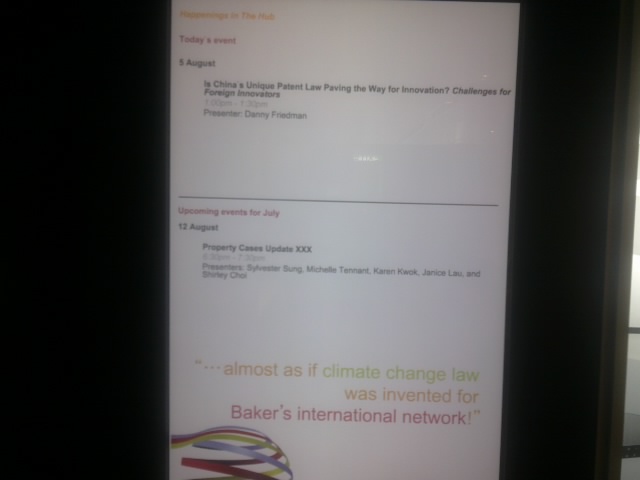
 Yesterday I gave a lunch presentation at the Hong Kong office of Baker & McKenzie. The title of my presentation: 'Is China's Unique Patent Law Paving the Way to Innovation?' about the challenges of foreign innovators because of the changes in the Third Amendment to China's Patent Law 2008. I was delighted to find such interested audiences at Baker & McKenzie's Hong Kong office and via video conferencing also at Baker's Shanghai and Beijing's offices and get excellent input of Baker's IP experts.

