Showing posts with label Taobao. Show all posts

Monday, September 05, 2011

Complaining about Taobao's IPR Complaint System and a MOU

When the International Intellectual Property Alliance (IIPA) testified for the USCC Hearing on “China’s Intellectual Property Rights and Indigenous Innovation Policy,” April 25, 2011, it focused on the software and recorded music industry. However, they also wrote a letter about the overall IP record in China, see here.

"Sites such as Alibaba.com, Aliexpress.com, GlobalSources.com, Made-in-China.com, DHgate.com, Taobao.com, and Tradetang.com are among the top online marketplaces selling videogame circumvention devices, as well as being cited by industry as offering other copyright infringing products to consumers and businesses, including scanned copies of commercial bestsellers (trade books) and academic textbooks. Unfortunately, most of these sites are unresponsive to rights holder takedown requests."

Alibaba was the only one "commended for their cooperation with videogame right holders in the removal of infringing items".

Seems that Taobao is open to suggestions that can improve the prevention and cessation of trade of IPR infringing goods.

In Hanzhou, Zhejiang province, the internet task force of the Quality Business Protection Committee (QBPC), "the China association of enterprises with foreign investment", had a roundtable meeting with Taobao. Topic of discussion was the less than perfect Taobao IPR complaint system, read here.

Online shopping site Taobao.com signed a memorandum of understanding (MOU) with the International Publishers Copyright Protection Coalition in Beijing, see here a very brief report by the China Daily.

The golden rule expressed by Scottish sinologist James Legge, advertised at a bus stop,
sponsored by the Shenzhen Universiade 2011
photo: Danny Friedmann

continue reading ...

Tuesday, April 12, 2011

Tim Smith's Guest Blog: Taobao Online Infringement Case

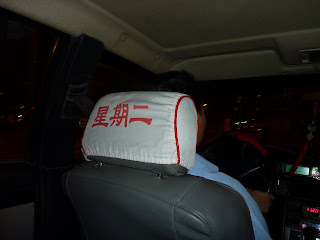
星期二 = Tuesday Photo Danny Friedmann
Taobao.com, the popular Chinese e-commerce platform, has appealed against a verdict handed down by a Shanghai court in late March that it should pay compensation of RMB 10,000 (around GBP 950) for its failure to take sufficient steps to prevent a vendor selling counterfeit products on its platform.

The claimant had sent seven letters to Taobao asking it to delete information supplied by the vendor regarding the counterfeit products. Taobao deleted the information but did not take any further action against the vendor such as freezing its account or checking other information uploaded by the vendor to the platform. Consequently, the vendor was able to maintain information about other counterfeit products it was selling on Taobao.

The first instance court stated that if a network provider deletes information after receiving a notice, this is a necessary condition of non-liability, but not a sufficient condition - it may need to do more. Taobao had failed to take further steps against this specific infringer - something its own IPR protection rules already contemplate - and consequently was liable for contributory infringement.

This marks a departure from previous decisions, which did not impose liability on Taobao if it immediately deleted the counterfeit product information. Article 36 of the Tort Liability Law deals specifically with internet providers, stating that "[w]here a network service provider knows that a network user is infringing upon a civil right or interest of another person through its network services, and fails to take necessary measures, it shall be jointly and severally liable for any additional harm with the network user."

The Chinese judiciary is currently drafting a judicial interpretation to deal with on-line liabilities and safe harbours in the copyright field, and it is hoped that will add further clarity to the developing jurisprudential picture.

Guest blog by Tim Smith, Rouse Beijing.
continue reading ...

Friday, March 18, 2011

Online infringement and ISP liability

The IP Dragon hasn’t been seen for 2 weeks now. IP Komodo wonders if his cousin might return soon and is worried about the mess, especially since IP Komodo tends to leave the remains of his lunch lying around...

Some interesting online IPR news IP Komodo has spotted:

Chinese authors accuse Baidu, China's biggest search engine of copyright violations, by its free online excerpts of unauthorized stories and books. On March 15, World Consumer Rights Day, more than 40 writers said in an open letter that Baidu stole their work and infringed their copyrights. Fang Zhouzi, (well-known for exposing academic fraud), told Xinhua that he could find almost all of his work in Baidu's online library. A welcome change to the parade of foreign complainants, IP Komodo thinks.

The State Level AIC is about to issue new regulations on internet IPR infringement aimed particularly at at tackling online piracy and counterfeiting. Evidence and jurisdiction will be covered, according to the vice Minister who announced it at the close of the National Peoples Congress session on Monday.

ISP takedown. Taobao.com, China's leading B2C website, announced on Monday that it will launch a campaign to stop online piracy and counterfeiting. The move comes after the site was labelled by USTR as a "notorious market". Last year, taobao.com deleted more than 5.7 million products involved in copyright infringement. Taobao will set up a special team responsible for checking for piracy and counterfeiting.

Guest post by IP Komodo Dragon
continue reading ...

Monday, March 14, 2011

The Lizard's weekly news roundup

Some of the more interesting news stories IP Komodo has spotted this week:

CNN reports on the growth in counterfeit wine trade in China. Destruction of the bottles is now common practice at the auction houses, for original fine wine bottles are not reused. Label errors are a common giveaway, but recorked fine wines (putting a cheaper 85 Lafite Rothschild into an 82 bottle is a high end way to make fakes). Now HK Customs have seized cheaper wines like Mouton Rothschild and Benfolds (Penfolds fakes) have been seen in China, following the rapid market growth. Read here.

AIC stats Here is a wonderful PRC enforcement statistic from SIPO. During a recent enforcement the campaign, AICs mobilized 1.595 million law enforcement officer/times to examine 3.877 million business owners, and 2,955 illicit dens were banned. Always important to focus on the means not the end…

The USTR report on notorious markets that fingers China's top search engine, Baidu and e-commerce giant Taobao as "notorious markets" for counterfeit and pirated goods is causing consternation in China. Various commentators have come out in defence of the sites, which are of course legitimate business sites as well as used by infringers, arguing that the US is politicizing the issue as regards China, when Ebay has the same problems.

Guest post by IP Komodo Dragon
continue reading ...

Wednesday, February 23, 2011

Turn of the Screw For E-Commerce Platforms: Circular on Regulating Sales Promotion of Online Shopping First Step

Take notice Taobao, Alibaba and all other Chinese e-commerce sites. January 5, 2011, the Ministry of Commerce (MOFCOM) promulgated a Circular on Regulating Sales Promotion of Online Shopping (商商贸发[2011]3号) for the commerce authorities (in all provinces, autonomous regions, municipalities directly under the central government, cities specifically designated in the state plan and the Xinjiang Production and Construction Corps). E-commerce is getting ever more important. However, it brings with it some challenges. Via online platforms counterfeit and pirated goods are sold, "replacing superior products with inferior products."

Article 5 Circular: "Strengthen the protection of intellectual property rights. In light of the special acts of cracking down aggression of intellectual property rights and manufacturing or sale of fake and shoddy goods, joint supervision shall be launched together with the industry and commerce authorities, quality inspection agencies, etc. and efforts in supervising online shopping platforms and operators shall be strengthened so as to crack down behaviors of infringing on intellectual property rights and manufacturing or selling fake and shoddy goods in promotion activities. Propaganda and education shall be strengthened to guide online shopping platforms and enterprises to perform their social responsibilities, carry out promotion in good faith and regulate business operation, and voluntarily reject illegal activities of infringing on intellectual property rights and manufacturing or selling fake and shoddy goods."

This is a sign of things to come. The e-commerce sites are made responsible what is going on on their platforms. So self-regulatory measures are stimulated. If the problems will not go away quick enough according to the authorities, binding regulation will follow. Decentralized enforcement systems, such as contributory liability is here to stay.
continue reading ...

Monday, February 07, 2011

What Is the Superlative of Contributory Liability?... Local State Supervision Liability?

Managing IP magazine, had a link to an interesting China Daily article, see here in which a State Administration for Radio Film and Television (SARFT) official was quoted as saying that it is "working on the establishment of an internet audio-visual programs industry association (..)". The application has been submitted and it now waiting approval to the Ministry of Civil Affairs.

Also interesting in the article is that the government intensified supervision over major internet enterprises, a precautionary move to stop piracy spreading. "In 2009, the number websites being supervised by local copyright authorities, reached 3,029. They include Taobao.com, Baidu, Sohu and Youku."

That means that if infringement still took place in that period, it was under local copyright supervision.

Taobao is China's e-commerce platform. And where eBay is sued by trademark holders in the U.S. (Tiffany), France (Hermès and LVHM) and Belgium (Lancôme), in China Taobao was sued for example by Puma; read Lee, Won Hee Elaine. 'Online Auction Sites and Inconsistencies: A Case Study of France, China, and the United States.' American University Intellectual Property Brief, Spring 2010, 50-57, here.

Jesse London (who is the managing editor of Cornell Journal of International Law), wrote an interesting note on China's Approaches to Intellectual Property Infringement on the Internet for the Internet Journal of Rutgers School of Law, volume 38, 2010-2011, read here. Mr London is comparing the IFPI cases against Baidu and Yahoo China and comes to the conclusion that the degree of good faith of the online service provider is crucial, but so is the degree of reasonableness of the demands of the trademark holder by insisting in the measures against infringement.

Youku (the Chinese equivalent of YouTube) had a lot of pirated Hollywood movies. But I checked a few times and they indeed seem to have cleaned up a lot of copyright piracy.
continue reading ...