Showing posts with label China. Show all posts

Wednesday, February 15, 2012

China's Influence On Non-Trade Concerns In International Economic Law

Maastricht University, Faculty of Law
Professor Paolo Farah organised with a grant from China-EU School of Law (CESL) in Beijing three conferences on China and Non-trade Issues. The first was held at the University of Turin (November 23-24, 2011), the second at Tsinghua University and the third was hosted by the Faculty of Law of the Maastricht University, the Netherlands, January 19-20, 2012.
Hall of fame at Maastricht University, Faculty of Law
The papers of the speakers presented will be collected in a book edited by Professor Farah called "China's Influence on Non-Trade Concerns in International Economic Law", will be published by Ashgate Publishing (UK), forthcoming in 2012. Beside the English version, there will be an Italian, Hungarian and Chinese version of the book, thanks to the CESL in Beijing.

Law scholars at Faculty of Law, Maastricht University
Professor Farah describes what non-trade concerns of international trade are and why they are of crucial importance: "Both public opinion and policy makers fear that international trade, in particular a further liberalization thereof, may undermine or jeopardize policies and measures on a wide variety of issues, for example, the protection of the environment and a sustainable development, good governance, cultural rights, labour rights, public health, social welfare, national security, food safety, access to knowledge, consumer interests and animal welfare." The list is not exhaustive and includes intellectual property rights.

Professor Paolo Farah
This author had the honour to present his paper 'Rise and Demise of U.S. Social Media in China' at the last conference hosted by the Faculty of Law of the Maastricht University. It is about how U.S. social media sites such as Facebook, Twitter and YouTube were cloned by Chinese social media sites, RenRen, Sina Weibo and Youku, then blocked from China, and then the Chinese clones got funding in the U.S. at the New York Stock Exchange or NASDAQ.

Speakers from right to left
Professor Anselm Kamperman Sanders, Arianna Broggiato, Danny Friedmann, Rogier Creemers
On January 19, the programme for experts included:
Professor Farah of the University of Turin and visiting scholar of Harvard Law School (East Asian Studies) and Professor Thomas Christiansen of Maastricht University, Political Science Faculty of Arts and Social Sciences, discussed the EU External Action toward China on Non-Trade Concerns in International Economic Law.
Professor Thomas Christiansen
Sergi Corbalán, Executive Director of the Fair Trade Advocacy Office (FTAO) in Brussels, was talking about fair trade and the new EU policies on Corporate Social Responsibility and Development.

Sergi Corbalán
Benjamin Barton of King's College of London, gave a presentation about the EU, China and international development.
Benjamin Barton
Professor Anselm Kamperman Sanders of the Faculty of Law of Maastricht University gave a presentation on China-EU Relations in the Field of Intellectual Property Law. He is not only Intellectual Property Law, Director of the Advanced Masters Intellectual Property Law and Knowledge Management (IPKM LLM/MSc), and Academic Director of the Institute for Globalisation and International Regulation (IGIR), but also Director of the Annual Intellectual Property Law School and IP Seminar of the Institute for European Studies of Macau (IEEM), Macau SAR, China.

Professor Anselm Kamperman Sanders
Arianna Broggiato, BIOGOV UNit, Université Catholique de Louvain, Centre for the Philosophy of Law (CPDR) talked about Genetic Resources and Traditional Knowledge at the Crossroads of Intellectual Property and the Environmental Regime.


Rogier Creemers, who made a transfer from Maastricht University to the Centre of Socio-Legal Studies at Oxford University presented his paper called Cultural Products and the WTO: China's Domestic Censorship and Media Control Policies. Rogier has an interesting blog called China Copyright and Media.

Rogier Creemers
On January 20, the programme focused on public health, product and food safety and consumer protection. Lukasz Gruszczynski of the Law Institute of the Polish Academy of Science talked about product safety in the framework of the WTO agreement on Technical Barriers to Trade.
Lukasz Gruszczynski
Denise Prevost of Faculty of Law of the Maastricht University discussed her paper Health Protection Measures as Barriers to EU Exports to China in the framework of the WTO Agreement on Sanitary and Phytosanitary Measures.
Denise Prevost
Enrico Bonadio of the Law School of the City University of London presented his paper on Plain Packaging of Cigarettes and Public Health under the TRIPs Agreement.

Enrico Bonadio
Paolo Vergano of FratiniVergano European Laywers in Brussels gave a Practitioner's Perspective on Specific Non-Trade Concerns in the Areas of Food Safety and Consumer Protection: A Comparative Analysis of WTO Notifications.

Paolo Vergano
Lorenzo di Masi presented his paper on The Protection of Public Health and Food Safety in East Asia Regional Trade Agreements (RTAs): ASEAN and China.

Lorenzo di Masi
Maastricht city on the banks of the Maas
continue reading ...

Tuesday, January 03, 2012

Golden Combination: Chow Tai Fook and Disney

"You can't stay in your corner of the Forest waiting for others to come to you. You have to go to them sometimes," said Winnie the Pooh.

Winnie the Pooh: "All this gold makes me crave for ... honey."
Exhibition at Yitian Holiday Plaza,
Windows of the World, Shenzhen
Photo Danny Friedmann

Now Winnie is talking the talk and walking the walk, since Disney joined forces with Hong Kong jewelry chain store Chow Tai Fook Jewellery Group Ltd., that just was listed to the Hang Seng Stock Exchange (and as of today is part of the Hong Kong Global Composite Index and Hong Kong Composite Index, see here). 

Chow Tai Fook raised 2 billion U.S. dollars in its Initial Public Offering to get enough funds to realise its plan to expand its points of sale in China, Hong Kong and Macau to 2,000 stores by 2016. Now, Chow Tai Fook has around 1,500 stores, mostly in China. In Macau it has about 80 stores. Chow Tai Fook also has stores in Taiwan, Singapore and Malaysia. 

Chow Tai Fook was awarded Disney's product licence, see here, to take advantage from the recognition of Disney's  iconic bear (which, according to girls and even grown up women has a high "cuteness" factor) and combine it with the jewelry retail expertise of Chow Tai Fook in China, Hong Kong and Macau.

Do you consider to engage in co-branding and you want to know more information about the legal implications, contact ipdragon at gmail.
continue reading ...

Monday, December 12, 2011

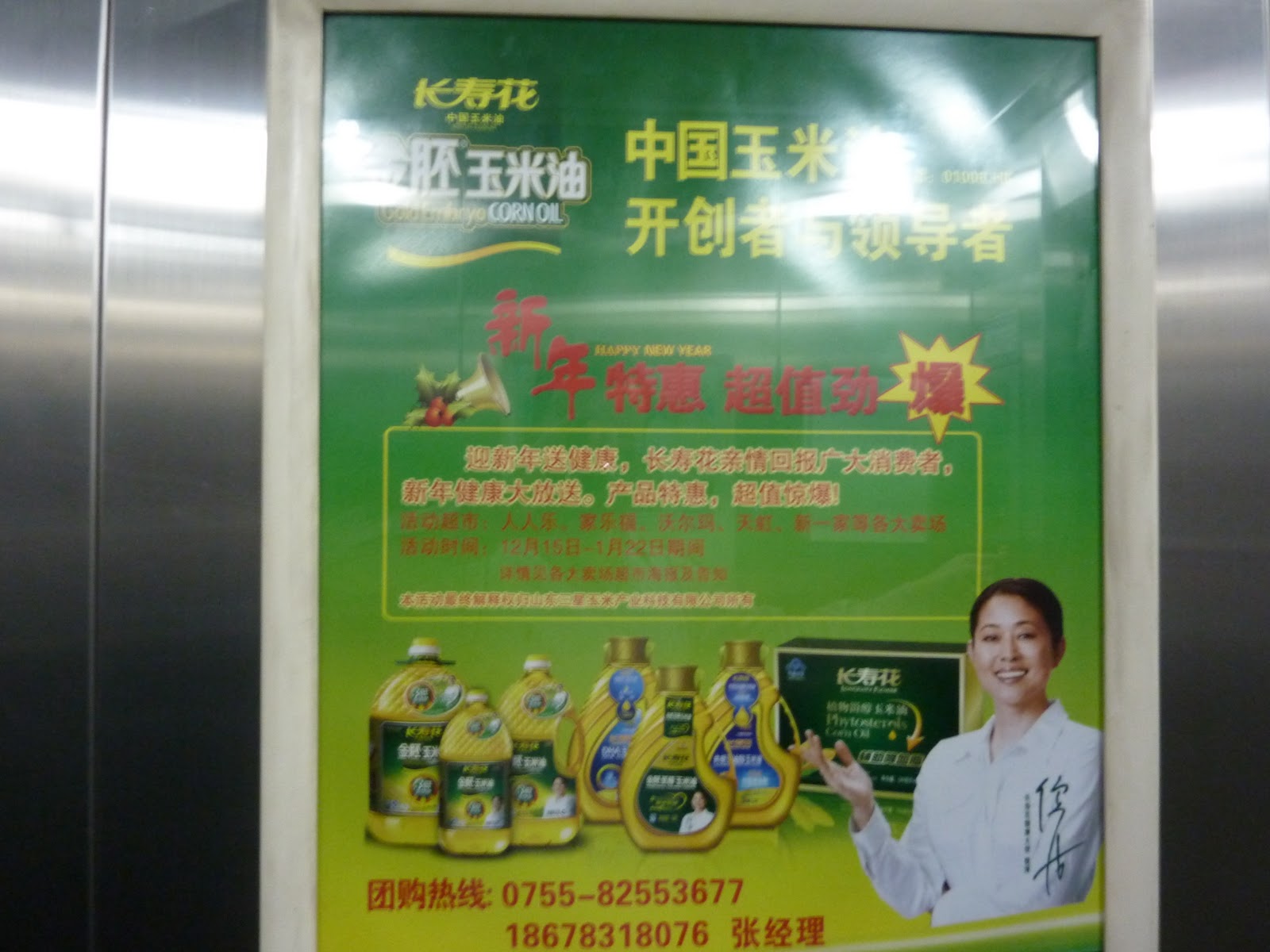
Bizarre Chinese Brand Approved By Pro-Life and Pro-Choice

Sometimes it is better to avoid literal translations. This might be an example: 
金 jīn 胚 pēi 玉 yù 米 mǐ 油 yóu = gold embryo corn oil. The association with embryos, even if they are golden, and corn oil, is probably not the most conducive to whet one's appetite. 

Photos are shot in a lift in Fu Tian Ti Yu Gong Yuan, Shenzhen
Photos: Danny Friedmann
continue reading ...

Tuesday, August 30, 2011

Taiwan Shining Intellectual Property Blueprint For China Or Wishful Thinking?

What works for Taiwan, 
does (not)
necessarily works for China,
and vice versa.
During the press conference for the "Piracy Out, Competitiveness Up" campaign in Taipei (Taiwan) the chief secretary of the Ministry of Economic Affairs, Hung Shu-min said that Taiwan could be a model worth modelling for China in regard to bringing down business software piracy levels. Read Stacey Wu and Deborah Kuo's article for Focus Taiwan here.

In the Eighth Annual BSA Global Piracy Study (released last May, 2011) Taiwan scored third best in Asia. Taiwan's business software piracy rate 37 percent (2010), four percentage points lower than in 2006. Only Japan scored better (20 percent) and Singapore (34 percent) in 2010. Taiwan scored better than Hong Kong (45 percent). Taiwan's relative low piracy has probably enhanced foreign investments in research and development. China still has still a serious business computer piracy issue 78 percent in 2010.

However, between 2006 and 2010 China also reduced its business software piracy rate with four percentage points (from 82 percent in 2006 to 78 percent in 2010). So relatively China reduced business software piracy as much as Taiwan.

China's Three Experimental Gardens
But I agree that the People's Republic of China is in a unique situation where it has the opportunity to look at  a variety of Chinese communities with very different systems, and pick and choose the best from each system. I am sure Beijing is already keeping a good eye on Hong Kong, Macau and Taiwan.

The question is whether the measures that worked in Taiwan will work on the Mainland too. To name one huge difference: size. If your territory is not as humongous as China's, like Taiwan's modest size (or much smaller Singapore) each problem is easier to fix. On the island of Taiwan the local and national nearly coincide. One can argue that in China all problems are getting aggravated because the tension between the local and national interests. Taiwan's legal system, and policy is very different from that of China. But learning from each other's successes and mistakes seems a good way to make a shortcut to progress.

Do you think China can emulate Taiwan's anti-piracy system? Or do you think each system is well tuned to its unique situation and to transplant a different legal system and policies are not recommended?

Ronald Yu, lecturer University of Hong Kong wrote on personal title, via email:
"I remember that when I first went to Taiwan you could buy lots of fake goods - fake shoes, pirated recordings, etc. but it has since cleaned up a lot. I have thought, for some time, that Taiwan could act as a barometer for China's future, and if my assumption holds, perhaps China shall soon have a very clean, effective IP regime."
continue reading ...

Saturday, August 20, 2011

Honey Laundering, Or How Chinese Lead And Indian Antibiotics Become Indian "Honey"

IP Dragon Weekend Edition

 (Mandarin mi4 feng1 Cantonese mat6 fung1) 
= honey bee  
 (Mandarin feng1 mi4 Cantonese fung1 mat6) 
= bee honey 

Two time Pulitzer-prize winning reporter for investigative journalism, Andrew Schneider wrote an interesting article about Chinese honey that is imported to the U.S. via India, Vietnam, Malaysia, Australia (and for some time Russia) that contains dangerous antibiotics and/or lead. The Chinese honey is imported via other countries into the U.S., since 2001. That was the year that the U.S Commerce Department imposed a tariff to prevent Chinese companies to dump cheap products on the American market.

Schneider: "Almost 60 percent of what was imported - 123 million pounds - came from Asian countries - traditional laundering points for Chinese honey. This included 45 million pounds from India alone." And India does not even have the capacity (the amount of bees) to produce 45 million pounds of honey.

Antibiotics
The only Indian part in the "honey" might be the dangerous Indian antibiotics. Chinese beekeepers fought an epidemic of foulbrood disease with antibiotics, which includes chloramphenicol from India, which can damage DNA and be carcinogenic, and can lead in about one out of 30,000 people to a fatal reaction. 

Lead
Some honey vendors use lead-soldered drums to collect and store the honey before it is collected by the brokers for processing. This can lead to lead contamination.

Sometimes no trace of honey
Schneider writes: "Another favorite con among Chinese brokers was to mix sugar water, malt sweeteners, corn or rice syrup, jaggery, barley malt sweetener or other additives with a bit of actual honey. In recent years, many shippers have eliminated the honey completely and just use thickened, colored, natural or chemical sweeteners labeled as honey." 

Read Schneider's article that reads like a Crime Scene Investigation. He writes that the Food and Drug Administration is unable to effectively the origin of the honey and its safety, about two institutions that can test the pollen, about the cat-and-mouse game of testing and ultra-filtration that removes or conceals floral fingerprints (pollen) and sweeteners or contaminants, and the lack of a definition of what honey is. Read Schneider's article for Food Safety News here.

Characters explained:
 left part of character means "insect", right part means "meets in groups", 
as bees tend to do.
 top part is "roof", middle part is "necessary", lower part is "insect". The top part and middle part combined is "silence". Not sure whether bees are silent or whether they keep buzzing in their hive. 
continue reading ...

Wednesday, August 17, 2011

Is China Copying Black Hawk Helicopter Technology That Crashed Into Bin Laden's Backyard?

"Why are you flying above me?""
"Keep flying, you are my stealth technology."
Isn't it the dream of each intelligence service that the state, military and trade secrets literally fly and crash upon your territory? This dream came true for the intelligence services in Pakistan when a US stealth helicopter Black Hawk crashed into the backyard of Bin Laden's hide-out in Pakistan.

A stealth helicopter has technology to conceal its presence, and avoids being detected by radar, sonor, infrared or any other detection method. However, if a stealth helicopter crashes and then is  detonated the "low observable technology" on its remaining parts is quite observable. And once the remaining parts of the stealth helicopter are not so stealthy anymore they are vulnerable to be copied.

Daniel Goure, vice president of the Lexington Institute said for ABC News that what really stood out was the little disk over the rotor which is really designed to both baffle the sound and to deny radar signature, read more here. Herman Lai reports for M.I.C. about whether China is trying to knock-off the US stealth helicopter that crashed in Bin Laden's backyard in Pakistan as a New York Times report suggests. Read here.

The intelligence forces of Pakistan deny this and the Chinese Ministry of Defense unsurprisingly replied: “This report is totally unfounded and extremely absurd.”

However Mark Mazzetti of the NYT wrote: "One person with knowledge of the intelligence assessments said that the American case was based mostly on intercepted conversations in which Pakistani officials discussed inviting the Chinese to the crash site. He characterized intelligence officials as being “certain” that Chinese engineers were able to photograph the helicopter and even walk away with samples of the wreckage. The tail has been shipped back to the United States, according to American officials." Read Mazzetti's NYT article here.

It might not be that absurd that Pakistan is willing to share its information on the helicopter with China, since Pakistan considers China as its best friend, read here.

The Global Post published a photo on which Pakistani boys collect the debris, see here.
continue reading ...

Monday, November 29, 2010

Parasitizing Trademarks of Drugs in China Breeds Resistant Malaria Parasite

World Health Organisation (WHO) officials say that counterfeit drugs and poor storage are endangering the health of millions of people in Asia.

Ron Corben wrote for Voice Of Amercia the article WTO Fears Growing Malaria Drug Resistance May Be Spreading (November 28, 2010): "In recent years, authorities cracked down against illegal factories in China. Meanwhile counterfeit producers have been found elsewhere, including Cambodia and Burma."

Simeon Bennett wrote for Asia Health Space the article Malaria Redux And Counterfeit Drugs (April 2, 2010): "In Pailin [Cambodia], a flood of counterfeit pills from China and elsewhere is helping to breed a superbug that resist even the most-effective medicine." Read .

This problem is recurring for years now:
2009: See Simeon Bennett's 2009 Bloomberg article Fake Malaria Drugs Spread, Breed Resistance to Lethal Parasite.
2007: Jill McGivering's 2007 BBC News article 'Tracking the fake malaria drug threat'.

Eye for an eye

What is a fitting punishment for these counterfeiters? Denying them help when they would contract Malaria? But even if you would impose the biblical sanction of an eye for an eye, a tooth for a tooth, how can you sanction someone that contributes to the death of not one but thousands of people who contracted Malaria and use counterfeit drugs that do not cure them?
continue reading ...

Sunday, January 31, 2010

Incremental Pharmaceutical Inventions in China and India: "No Need to Reinvent the Wheel"

For those who missed it, in 2008, the Intellectual Property Association of Japan (IPAJ) published an interesting article by Parama Sinha Palit and Bhaskar Bhattacharya called 'Does Intellectual Property Laws in India and China Encourage Innovation'. Messrs Palit and Bhattacharya, both senior associate with Corporate Law Group are advocates of the patentability of incremental, cumulative or adaptive pharmaceutical inventions. They opine that China is doing a much better job than India in this respect. India seems to discourage incremental inventions, while China has utility (model)-patents for these kind of inventions.

"It has been rightly pointed out that not recognizing incremental innovation in the pharmaceutical industry is like asking medical researchers to reinvent the wheel."

Read their IPAJ article here.
continue reading ...

Tuesday, July 14, 2009

Article 6ter Paris Convention Online: Hong Kong (2), China (0), Netherlands (37)

March 31, 2009, WIPO's first electronic publication of signs, emblems etc. protected under article 6ter Paris Convention for the Protection of Industrial Property, see here. On this day (July 13, 2009), if you type in China, you see only the emblem and flag of Hong Kong S.A.R. witn the stylised form of Bauhemia Blakeana. That is a very small number for such a big country such as the People's Republic of China (0) and Hong Kong (2), compared to the tiny Netherlands which protects 37 signs, emblems (including for such collective marks as Holland Cheddar Cheese etc), Germany (128), USA (117), United Kingdom (38), Italy (32). Then again Japan and France each only had two signs in the database.
continue reading ...