Tuesday, January 31, 2006

Harry Potter will be first released in China, thanks to piracy

CAV Warner Home Entertainment, a joint venture of Warner Home Video and China Audio and Video Corporation will launch Harry Potter and the Goblet of Fire DVD first in China. If it would do otherwise, it reckoned, pirated DVDs would flood the Chinese market and there would be no market left for legitimate products.

Read here.

continue reading ...

Monday, January 30, 2006

HK Hight Court's message: uploaders you can hide, but we'll find you

The Hong Kong High Court ruled Thursday that uploaders of copyrighted music could no longer hide behind a "cloak of anonymity" on the Internet.

Jonathan Cheng wrote an article about it for the HK Standard here.
continue reading ...

When will rampant piracy in China stop? Mark Cohen: "Don't know." Bill Gates: "2016"

Mark Cohen, the intellectual property lawyer dispatched to China in 2004 to protect U.S. IP rightholders against piracy. Cohen is officially on assignment from the U.S. Patent and Trademark Office.

Cohen: "The question is not, is there law. It's what law is being enforced and where." The problem, say attorneys and industry executives, is as much one of infrastructure as of experience. Improving China's enforcement of its IPR laws requires substantial changes to its legal system."

"Part of the difficulty in enforcement rests in overall problems with China's legal system, as well as the Chinese Government's desire to ensure that the economy is stable, particularly in the countryside. If courts are corrupt, or government officials accept bribes, or if local courts or administrative officials tend to rule in favour of local interests, without any corresponding checks and balances, then the IPR system will necessarily be compromised," Cohen told Managing Intellectual Property.

Read more here.

The Financial Times features a profile of Cohen here (paid subscribtion). Cohen may be specialist in IP in China but when asked when the compliance in China will be up to US and European levels, he said he didn't know. Bill Gates, however, thinks it will end in a decade.

Read more here.
continue reading ...

Saturday, January 28, 2006

HK governement recruits youth as informers in battle against internet piracy

The experience with the Red Guards, overzealous youth who handed in their peers to the communist authorities, if they manifested anything 'bourgeois' during the Cultural Revolution, is painfully fresh for many people in China. Now it seems that the Hong Kong government is inspired by something familiar; recruiting youths to root out online piracy. Bit scary.

See the Managing Intellectual Property article here.

Hat tip to LawGeek Jason Schultz.
continue reading ...

TGIF

The Chinese meaning of copyright

"Copyright; the right to copy"

previous TGIF next


continue reading ...

Friday, January 27, 2006

Chinese perception of IP: 'fair game'

Peter Warren wrote an article for The Guardian about the Chinese perception of hacking and to a lesser extend about their perception towards infringement of intellectual property. You will find the latter passages quoted below.

Feng Ma, an expert on China for the Taiwanese intellectual property law firm Osha Liang:

"most illicit users in China are concerned with more mundane issues such as getting free goods and software and making money. "Intellectual property is seen as fair game, especially because western companies put their factories in China so they can get cheap labour and avoid environmental rules."

Arthur Yuan, a lawyer at US-based Senniger Powers, a leading intellectual property (IP) firm:
"The [Chinese] population does not consider the IP of companies abroad of value. They think that as long as it is for the glorification of the government, then the taking of information is justified - and they see no reason why they should not take a shortcut if it is possible."

Read here more.
continue reading ...

NFL takes action against counterfeit merchandise in US from China

The National Football League, Pittsburgh Steelers and Seattle Seahawks filed suit in Wayne Circuit Court on Monday naming three suspected counterfeiters and 400 "John Doe" counterfeiters. Circuit Judge John A. Murphy signed a temporary restraining order allowing NFL investigators to seize phony goods and dispose of the merchandise by destroying it or donating it to charity.
Most of the counterfeit merchandise seems to come from China and enters the United States through New York and Los Angeles.

Some of the counterfeiters seem to use some creativity:
"One seized hat, for example, has "Detroit" stitched onto it and an Olde English "D" like the one worn by the Tigers baseball team inside the flaming circle logo used by the Tennessee Titans football team."

Read David Shepardson and Ronald J. Hansen's artikel for the Detroit News here.
continue reading ...

Taiwanese crackdown on Sgt. Keroro frogs

The Japanese animated film Sgt. Keroro is popular in Taiwan, Hong Kong, China and other Asian countries. It features five alien frog characters. Rampant piracy of the merchandise and unauthorized downloading of the animated film from the Internet is infringing the intellectual property rights of Mighty Media Co., the Taiwanese franchisee of the Sgt. Keroro copyright holder in Japan.

Read more here.
continue reading ...

Thursday, January 26, 2006

Three months campaign against servers with pirated content and software

Remember the somewhat vague report about the Chinese crackdown at the end of last year on the 17 production lines that were making pirate CD's were shut down and 79 newspapers and 50 types of software games were banned? See here.

Now Faye Wang has written for Interfax China an article about a crackdown that also took place at the end of last year (September to December) on internet servers that infringed intellectual property rights. Her source is Zhao Xiuling, head of the copyright management department under the National Copyright Administration of China (中文).

"During a three-month campaign from September to December of last year, authorities either fined or brought criminal indictments against 29 Chinese websites found to be providing pirated online gaming services and cheat-software, Zhao said at the 2005 China Game Industry Annual Conference (CGIAC) in the city of Xiamen, Fujian Province."

Results of the three months anti-piracy campaign:
Shut down a total of 76 websites that were providing pirated internet services and content
Confiscated 39 network servers that were used to host pirated content and services
Ordered 137 websites to remove content and services that violated intellectual property rights.
Investigation of a total of 172 cases of internet copyright infringement, these involved a total of 173 Chinese websites and 405 network servers

Wang ends her article with an illuminating line-up of all governement organisations involved:

  • Publicity Department of the Central Committee of the Communist Party of China
  • Anti-pornographic and Illegal Publications Working Group
  • General Administration of Press and Publication
  • National Copyright Administration
  • Ministry of Public Security
  • Ministry of Information Industry
  • Ministry of Culture
  • State Administration for Industry & Commerce

It may be a comprehensive campaign, but all these organisations involved is bit much, to my taste. Why can't the Ministry of Public Security, who has a kind of police force, not handle it alone?

Read Wangs Interfax China article here

continue reading ...

Wednesday, January 25, 2006

Second USTR request to China to pinpoint deficiences in IP enforcement


On January 20th, 2006 deputy U.S. Trade Representative Peter Allgeier explained the legal rationale of the first request based on article 63 (3) of the TRIPS Agreement to outline the steps China is taking to comply with TRIPS in a letter to China's ambassador to the WTO, Mr. Sun Zhenyu.

"In the letter (IP Dragon: October 25th, 2005), Allgeier said the USTR is concerned about Chinese statements noting that the relevant section of the international agreement on intellectual property, or the TRIPS Agreement, refers to a member's right to request information but makes no mention of another member's requirement to respond to those requests."

"Should China fail to show progress in curbing rampant piracy and counterfeiting (IP Dragon: China should do so based on article 41 (1) of the TRIPS agreements), the White House -now under intense pressure from members of Congress concerned about the issue - could ask for a WTO panel to settle the dispute. " See more about this here.

USTR demands information in six areas (all in the spirit cooperation and mutual understanding of course):
1. legal basis for the claim;
2. types of remedies imposed
3. timing and location of the enforcement actions;
4. whether cases were transferred to criminal authorities;
5. whether rights holders were foreign or Chinese;
6. types of products involved.

According to the USTR China has recognised the cases as being related to the question of its compliance with the TRIPS agreement. China mentioned these cases December 9, 2004 during the TRIPS council review, see IP/C/34, paragraphes 6, 52-55, 62, 75 and 76.

Read Elisabeth Price's article for Dow Jones News here, Doug Palmer's take on the matter for Reuters here, FT's Christopher Swann and Edward Alden's article here or read the USTR letter yourself here.   
continue reading ...

Crackdown on online copyright infringements

According to an article in CRI a spokesperson for the National Copyright Administration (中文)said that China solved 172 web copyright infringements cases over the past three months since the launch to curb online piracy.

Read more here.
continue reading ...

Tuesday, January 24, 2006

China and Taiwan Toolkits against IP infringement

The US goverment has started with Strategy Targeting Organized Piracy (STOP!) and provides a China Toolkit, Taiwan Toolkit etc. Here the basics are explained about copyright, trademark and patent law and how you could reduce infringement of goods at trade fairs etc.

Relevant US governement resources can be found here.

See StopFakes.gov.
continue reading ...

Crackdown on pirated disks in Guangxi

In the Guangxi Zhuang Autonomous Region 364.000 pirated audio and vido discs were seized.

Ning Xiuyu, an official with the region's cultural administration said that the campaign has produced tangible effects. "But we know piracy is still rampant in some places, especially in the production and sale of discs under pseudonyms," Ning said.

Read more here.
continue reading ...

Monday, January 23, 2006

ChinaDaily: some IPR related facts of last year

ChinaDaily is giving some IPR related facts of last year. For example:
In August Managing Intellectual Property (paid subscribtion), named four Chinese people, including Vice-Premier Wu Yi, as the World's 50 Most Important IP Figures in 2005. Wu was also on the 2004 list.

Read here.
continue reading ...

Dequan's overview of patent strategies

ChinaDaily asked Beijing based Dequan Law Firm to give an overview of patent strategies, including cross-patenting and the patent net.

Read here.
continue reading ...

Friday, January 20, 2006

TGIF


IP lawyers, modern warriors with different weapons

Winning a legal battle in China requires more than the will to succeed. Jones Day's J. Benjamin Bai quoted Sun Tzu's Art of War in relation to competitors that want to invalidate your clients' patents:

"Know your enemy, know yourself, fight a hundred battles, win a hundred battles."
But he also warned, "If you know yourself but not the enemy, for every victory gained you will also suffer a defeat." This century-old war strategy still applies today, albeit a different battle.

Read here Bai's 'Are your Chinese patents at risk?' (already reviewed yesterday, see here).

previous TGIF next
continue reading ...

WTO dispute over geographical indication looms between Taiwan and China

Taiwan's Mainland Affairs Council (MAC) is considering whether it will send a complaint to the WTO dispute resolution body about infringement of trademarks and copyrights.

What's the problem? Chinese companies have registered their products with names of places in Taiwan, such as "Kukeng Coffee," "Hsinchu Rice Noodle," "Hsinchu Meat Balls," and "Chihshang Rice." And Chinese tea products that bore names of places in Taiwan, such as "Alishan," "Yushan," "Sun Moon Lake," and "Hsitou." So it's about geographical indications, a sign used on goods that have a specific geographical origin and possess qualities or a reputation that are due to that place of origin, more.

Citing a survey report, MAC Chairman Joseph Wu said that China's trademark department appears to have have approved applications of trademarks bearing the names of those well-known places in Taiwan. Of these applications, four were filed by companies invested in by Taiwanese people and three by Chinese companies, he said.

According to WTO and other agreements, the names of well-known places should never be part of any registered trademark, as it might create a false impression of the origin of the product which is more than likely to have been manufactured in another place.


See article here.

Relevant law:

Article 1(2) of the Paris Convention includes some indications of source and appellations of origin as subject matter of industrial property protection:
The protection of industrial property has as its object patents, utility models, industrial designs, trademarks, service marks, trade names, indications of source or appellations of origin, and the repression of unfair competition.

Article 10(1) provides for indications of source the same remedies prescribed in respect of goods unlawfully bearing a trademark or a trade name in case of direct or indirect use of a false indication of source of the goods or the identity of the producer, manufacturer, or merchant:
The provisions of the preceding Article shall apply in cases of direct or indirect use of a false indication of the source of the goods or the identity of the producer, manufacturer, or merchant.

Article 1(1) of the Madrid Agreement for the Repression of False or Deceptive Indications of Source on Goods :
All goods bearing a false or deceptive indication by which one of the countries to which this Agreement applies, or a place situated therein, is directly or indirectly indicated as being the country or place of origin shall be seized on importation into any of the said countries.

Article 2 of the Lisbon Agreement:
(1) In this Agreement, "appellation of origin" means the geographical name of a country, region, or locality, which serves to designate a product originating therein, the quality and characteristics of which are due exclusively or essentially to the geographical environment, including natural and human factors.
(2) The country of origin is the country whose name, or the country in which is situated the region or locality whose name, constitutes the appellation of origin which has given the product its reputation.

Article 22 of Trade aspects of Intellectual Property Rights TRIPS on the protection of geographical indications within the framework of the WTO:
1. Geographical indications are, for the purposes of this Agreement, indications which identify a good as originating in the territory of a Member, or a region or locality in that territory, where a given quality, reputation or other characteristic of the good is essentially attributable to its geographical origin.
2. In respect of geographical indications, Members shall provide the legal means for interested parties to prevent:
(a) the use of any means in the designation or presentation of a good that indicates or suggests that the good in question originates in a geographical area other than the true place of origin in a manner which misleads the public as to the geographical origin of the good;
(b) any use which constitutes an act of unfair competition within the meaning of Article 10bis of the Paris Convention (1967).
3. A Member shall, ex officio if its legislation so permits or at the request of an interested party, refuse or invalidate the registration of a trademark which contains or consists of a geographical indication with respect to goods not originating in the territory indicated, if use of the indication in the trademark for such goods in that Member is of such a nature as to mislead the public as to the true place of origin.
4. The protection under paragraphs 1, 2 and 3 shall be applicable against a geographical indication which, although literally true as to the territory, region or locality in which the goods originate, falsely represents to the public that the goods originate in another territory.

Articles 23 and 24 of TRIPS can be relevant too.

More about international treaties protecting geographical indication here.

Article 16 of the Chinese Trademark Act:
Where a trademark contains a geographic indication of the goods in respect of which the trademark is used, the goods is not from the region indicated therein and it misleads the public, it shall be rejected for registration and prohibited from use; however, any trademark that has been registered in good faith shall remain valid. The geographic indications mentioned in the preceding paragraph refer to the signs that signify the place of origin of the goods in respect of which the signs are used, their specific quality, reputation or other features as mainly decided by the natural or cultural factors of the regions.


continue reading ...

Thursday, January 19, 2006

Chinese crackdown targeted at production lines of pirated CD's and illegal newspapers and games

At a crackdown last year, 17 production lines that were making pirate CD's were shut down and 79 newspapers and 50 types of software games were banned. Last Tuesday Liu Yunshan, head of the governing Communist party's Publicity Department said according to CanoeMoney of Canada at a conference: officials must "severely crack down on illegal publications, purify the cultural market, effectively curb various kinds of piracy and strengthen intellectual property right protection"

Read more here.

A better article about it you'll find here.
continue reading ...

Philips introduces Veeza to curb illegal use of CD-R


Dutch company Philips Electronics is to adopt within six months a new licensing system, called Veeza, to curb the illegal use of its patented CD-R technology.

Veeza was developed so that throughout the chain from customs, traders, retailers to consumers you can easily differentiate a licensed disc from an unlicensed one. This is possible because Veeza has three marks:

  • a logo and site registration number on each disc;
  • a fraud-resistant label with the logo and serial number on each packing carton;
  • and documentation for each shipment.
"Philips co-invented the CD-R disc system and has a portfolio of patents essential for the manufacture and sale of CD-R discs. Under Veeza, Philips has cut royalties from 4.5 US cents to 2.5 US cents per piece, and it will charge patent royalties based on the number of shipments.
Under the previous system, CD-R manufacturers received a licence from Philips for total production that was valid until the patent expired, Peters explained."

"Currently about 95 per cent of the CD-R discs in the world are produced in China, including Taiwan. An estimated 50 per cent of those made in China are licensed, according to James Liu, senior legal counsel of Philips IP and Standard."

Read Zhu Boru's article for the ChinaDaily here.
continue reading ...

Patent procurement, licensing and litigation in China

The Institute for Law and Technology (ILT) conference on patents in China will start today (January 19-20) in San Francisco, see here. According to the ILT there are still US patent attorneys that counsel against seeking patent protection in China and "waisting your money".
It wrote that only one US company (standing next to its Chinese, Japanese, Korean and European peers) ranks among the top 10 patent filers. Which one? IP Dragon doesn't know yet. Please let me know.

A case in point of the value of Chinese patents for foreign companies is the story about SigmaTel. Read the article Kirk Ladendorf wrote for the American-Statesman here.

Ok, but what if you got yourself Chinese patents, is your company safe? One of the speakers on the conference is Marjory Searing, vice president Public Affairs of Pfizer Inc., the pharmaceutical company that found out that their Chinese patent was invalidated by the SIPO's Patent Re-examination Board, read here. J. Benjamin Bai of Jones Day wrote an interesting piece about the process of invalidation and the criteria the Patent Re-examination Board is using, read here.
continue reading ...

Forged trademark memory sticks seized by HK customs

"Hong Kong customs seized memory sticks of forged trademark worth 1.03 million HK dollars (132,989 U.S. dollars). The 535 memory sticks were found in a 26 year old man's rucksack when he entered the Hong Kong Special Administrative Region (HKSAR) of China through one check point connecting the southeastern Chinese city of Shenzhen. He will be charged with 'importing goods to which a false trade description was applied.' Importing goods to which a false trade description is applied is a serious offense, according to HK law. The maximum penalty is five years' imprisonment and a fine of 500,000HK dollars (about 64,557 U.S. dollars)."

Source Xinhua News

More about Customs as an inexpensive and effective alternative to private litigation here.
continue reading ...

Wednesday, January 18, 2006

In-Stat is drawing rosy picture Chinese music industry

"Piracy is still the key blocking issue to developing China’s digital music industry, but online piracy is being attacked both by the government and industry music labels."

But according to a report (paid) by In-Stat there is light at the end of the tunnel:

"The end of 2007 will be the turning point for China’s legitimate digital music market. Unauthorized music companies are now in the process of, or have already made their services legitimate. Also, with the emergence of mega online music stores, legitimate online music will become a dominant service for users."

"Music labels, in association with the International Federation of Phonographic Industry (IFPI), are filing and winning copyright lawsuits in China."

Read more here
continue reading ...

SIPO welcomes cooperation with Danish Patent and Trademark Office


Director General Jesper Kongstad of Danish Patent and Trademark Office (DKPTO) visited SIPO deputy commissioner Li Yuguang. The latter made proposals on future cooperation between SIPO and DKPTO. The two sides agreed to strengthen their cooperative relations, especially on IP legislation, patent examination, patent information services and international cooperation. Right, but no concrete coordination treaties were signed.

Read SIPO press release here.
continue reading ...

The inexpensive and effective alternative to civil litigation in case of IP infingement

J. Benjamin Bai and Kam W. Law (both lawyers at Jones Day wrote an interesting article about customs protection.
China promulgated its customs protection regulations in 1995.
December 2003, the regulations were revised to increase the power of the customs to investigate and reduce the burden of the IP owner to protect their rights.
November 2004, new penalty regulations became effective.

Chinese customs protection regulations apply to both import and export. There are two modes of Chinese customs protection:
  • the passive mode in which the customs seizes infringing products upon application of the IP owner who supplies specific information. The customs has no authority to investigate infringement allegations and the IP owner has to resort to a court to decide infringement issues;
  • the active mode in which an IP owner records its IP with the General Administrator of Customs of China in advance, and the customs proactively monitors shipments of goods for possible infringements. The customs have the authority to investigate infringement allegations.

Find the article here.

continue reading ...

Tuesday, January 17, 2006

DSM starts patent case against Hangzhou Pivot

Dutch chemial DSM-daughter Dyneema starts a patent case against Chinese Hangzhou Pivot. According to DSM Hangzhou Pivot is infringing its Dyneema-fibre patent, used for armouring cockpit doors. DSM asks the Paris Court to order an injunction of the sale of fibre and rope by Hangzhou and a recall of all sold materials. Besides, DSM demands compensation damages.
During the state security exhibition Milipol 2005 in Paris, DSM took possession of the materials of Hangzhou Pivot, because they allegedly infringed DSM's patent.

Source De Telegraaf/ANP-ANX
continue reading ...

China's counterfeiting explained plus 13 anti-counterfeiting strategies

Tod Datz wrote, a great article called 'Faked in China' for the Chief Security Officer Online.

The article starts with the lost of innocence of Will-Burt Co. , a producer of night-scan telescoping masts. After a honeymoon week Shenzhen Superway, Will-Burt's exclusive distributor for China had re-engineered the products and had began, sans gene, with large-scale counterfeiting.

After this cautionary tale, the article continues with some explanations for the rampant IP infringements in China. Then it enlightens readers about three different kinds of infringement operations: by legitimate factories, joint-ventures and underground facilities. Besides Datz gives some explanations of the dichotomy between national action and local inaction on the enforcement of IPR.

After these plausible explanations Datz comes up with 13 anti-counterfeiting strategies:

1. Do your homework
2. Travel to China
3. Budget smartly
4. Protect your IP
5. Consult with officials from your governement
6. Pursue criminal enforcement if needed
7. Look at alternative enforcement strategies
8. Have a notarized, legalized power of attorney available
9. Show your presence at the factory
10. Have key people sign a noncompete agreement
11. Chief Security Officers (CSO's) can lead in retaining private investigators
12. Consider anticounterfeiting technologies for your products
13. Look to industry associations, such as the Quality Brands Protection Committee, for help

Read the article here.
continue reading ...

KOTRA report: Korea better investment environment than China

Invest Korea, Korea Trade-Investment Promotion Agency's foreign direct investment promotion arm, compared South Korea to China in seven areas for business conditions and six for living conditions.

On the frontpage of Invest Korea (no permanent link) IP Dragon found:
"The intellectual property rights environment is constantly improving in Korea considering that the United States Trade Representative (USTR) has moved Korea from the Priority Watch List to Watch List", contrary to China.

"Gyu-Joon Hwang, head of the Investment Service Team of Invest KOREA noted "We need to focus our investment promotion strategies on Korea’s comparative superiority over competing nations such as China".

Read an article by Yoo Soh-jung for the Korea Herald here.
continue reading ...

The neglected risks of the PRC

The Taiwanese Mainland Affairs Council published an assessement of the social and economic risks (including legal risks as counterfeiting).

Read here.
continue reading ...

Ferrero Rocher's bitter sweet victory

Singapore's Today Online wrote about Ferrero Rocher's 'sweet' taste of victory against Montresor, a Sino-Belgium joint-venture (Zhangjiagang) who was ordered by the Tianjin High court to pay 700.000 yuan to Ferrero because of counterfeiting. But then again, Ferrero Rocher has spent 800.000 dollars defending its IPR in recent years.

Read the article here.

Update: Anticipated Supreme People's Court Decision in Counterfeit Case Between Montresor and Ferrero, see here.
continue reading ...

Monday, January 16, 2006

Colour-combination registrable, however, in casu lacks distinctiveness

Rouse IPEX issue No. 268 reported on a landmark litigation implying registrability of a colour-combination trade mark. We can now read in Rouse IPEX issue No. 270 that the Beijing No.1 Intermediate People's Court has given its decision:

"That, although there is no reason, in principle, why colour-combination marks should not be registrable, the Plaintiff's colour-combination mark lacked distinctiveness and was, therefore, unregistrable."
"The Court considered that where a mark acquires distinctiveness, it can be registered, whether it is a colour combination mark, or a mark of any other type. However, in this case, the Plaintiff's colour-combination mark was not distinctive. The mark was too simple for consumers to recognise it as an indication of source of the goods. Thus, the Court ultimately ruled in favour of the Defendant, rejecting the Plaintiff's claim."
Relevant law
Article 15(1) of TRIPS: Any sign, or any combination of signs, capable of distinguishing the goods or services of one undertaking from those of other undertakings, shall be capable of constituting a trademark. Such signs, in particular words including personal names, letters, numerals, figurative elements and combinations of colours as well as any combination of such signs, shall be eligible for registration as trademarks. Where signs are not inherently capable of distinguishing the relevant goods or services, Members may make registrability depend on distinctiveness acquired through use. Members may require, as a condition of registration, that signs be visually perceptible.
Article 8 of the Chinese Trademark Law: Any visual sign capable of distinguishing the goods or service of one natural person, legal person or any other organization from those of others, including words, devices, letters, numerals, three-dimensional symbols, combination of colours or the combination of the said elements may be applied for the registration of a trademark.
Article 11 of Chinese Trademark Law: The following shall not be registered as a trademark: (3) trade marks which are devoid of any distinctive character.
continue reading ...

China: If you can control it there, you can control it anywhere

If they can control it there, they can control it anywhere, it's up to you, China. US assistent secretary of commerce for market access and compliance David S. Bohigian, said that the United States will closely watch measures by the Chinese government to protect intellectual property in regard to the Olympics.

Read more here.
continue reading ...

Friday, January 06, 2006

TGIF

I'll be back
IP Dragon is stretching the meaning of TGIF a bit and goes on holiday.
I'll be back January 16th with lots of inspiration, I hope.

previous TGIF next
continue reading ...

Thursday, January 05, 2006

Take note: IPR in China Conference: Management, Protection and Enforcment

IBC is organising the IPR in China Conference, Monday 20th March 2006 in Café Royal, London. It is especially relevant for companies suffering from infringement or considering setting up operations in China.

If you look at the panelists of the conference it promises to be a very interesting day indeed:

Keynote Address:
Ian Harvey, Chairman of the Intellectual Property Institute

Special Presentation:
Paul Ranjard, Associé, Adamas, Beijing Chairman Intellectual Property Working Group, EU Chamber of Commerce China

Speakers from China with Direct Experience:
Connie Carnabuci, Partner, Freshfields Bruckhaus Deringer, Hong Kong
Matthew Laight, Head of Intellectual Property Group Asia, Bird & Bird, Beijing & Hong Kong
Douglas Clark, Partner, Lovells, Shanghai
Luke Minford, Partner, Rouse & Co International, Beijing
Ben Goodger, Executive, Willoughby & Partners

Disclaimer: IP Dragon is sponsored by IBC
continue reading ...

SIPO: Foundation of Leading Group for National Intellectual Property Strategy


During the fifth Trilateral Policy Dialogue Meeting between the Commissioners of SIPO, Japan Patent Office (JPO) and the Korean Intellectual Property Office (KIPO) that was held in Taej, South Korea on December 1st, 2005, Chinese commissioner Tian Lipu introduced some new developments:

  • the situations of patent examination practices (see more here)
  • measures enacted by the Chinese government to strengthen IP protection
  • foundation of the Leading Group for National Intellectual Property Strategy Formulation of the P.R. China.
Besides, the three Commissioners exchanged ideas on cooperation.

IP Dragon is curious about the 'Leading Group for National Intellectual Property Strategy Formulation'. Sounds like another institution that makes research on IP in China less transparant. Hopefully IP Dragon will be wrong.

Read here.
continue reading ...

Fakes concealed at Xiushui, Xingbake makes public apology

Columnist Philip Lin of Pacific Epoch is somewhat optimistic about brand protection in China now that the fakes are more concealed at Silk Street (Xiushui) mall after the Beijing operator and vendors got convicted and were ordered to pay 13.000 dollar in damages to Burberry, Chanel and other luxury brands (see more here).

Regarding the Starbucks victory Philip finds it particularly noteworthy that Shanghai Xingbake had to make a public apology public apology in the Xinmin Evening News in a land obsessed with not "losing face" (see more here).

Read Philip's column here.

continue reading ...

Guthrie pleads guilty of criminal copyright and trademark infringement

Randolph Hobson Guthrie III pleaded guilty of criminal copyright and trademark infringement, illegally importing infringing goods and money laundering before U.S. District Judge Louis Guirola Jr (Southern District of Mississippi), after being deported from China to the US. Gurthrie faces up to five years in prison and a fine of up to $250,000. He will be sentenced March 14. Read here.

However Gurthrie was not found by the US Immigration and Customs Enforcement (ICE) agents at a flea market with pirated DVD's, as Robin Fitzgerald wrote. He was arrested in Shanghai on July 2, 2004 by Chinese policemen while being filmed by two cameramen of the Chinese reality TV show called Oriental Police. It was the culmination of Operation Spring, the first joint Chinese American effort to enforce intellectual property laws. The cooperation was between US Immigration and Customs Enforcement (ICE), the Economic Crime Investigation Department of the Chinese Ministry of Public Security, the Shanghai Public Security Bureau and Motion Pictures Association of America.

Joshua Davis wrote a great article about Guthrie's downfall for Wired: The Decline & Fall of Randolph Hobson Guthrie III. Read here.

April 2005 Shanghai No. 2 Intermediate People's Court convicted Guthrie and Abram Cody Thrush of distributing more than $840,000 worth of pirated motion picture DVDs on the Internet. Besides the two Americans, Wu Dong and Wu Shibiao, two Chinese accomplices in the illegal counterfeiting operation were convicted. Wu Dong received a jail term of one year and three months, and a fine of 10,000 RNB. Wu Shibiao received a fine of 30,000 RNB. See more here.

Chinese prosecutors said Guthrie has illegally sold some 180,000 pirated DVDs around the globe through eBay.com and a Russian based Web site. Guthrie and five others were arrested in 2004 and more than 210,000 counterfeit DVDs were seized and three warehouses containing the pirated material were destroyed. Guthrie was sentenced to 30 months in Chinese prison, fined approximately $60,000 and deportation upon the completion of his sentence.

However Guthrie was deported before serving any of his Chinese sentence, Department of Homeland Security officials said.
July 2005 the Southern District of Mississippi issued an 18 count indictment against Guthrie (who was still in Chinese custody at the time) including conspiracy, smuggling, trafficking in counterfeit goods, money laundering conspiracy, criminal forfeiture, and criminal copyright infringement violations. He was expelled to the U.S. in September 2005 and ICE agents arrested Guthrie immediately upon his arrival in Los Angeles.
Read here and here.
continue reading ...

Wednesday, January 04, 2006

Some BusinessWeek advice about IP for doing business in China

The renowned business magazine gave some IP related advice, although very short. The black box method was mentioned to prevent possible infringements: to produce component parts in multiple locations around the country and then assembling them in a single, low-tech factory. And besides, a recommendation was made for Hong Kong's developed legal system, although more expensive than that of mainland China.

See one subheading before the end of the article, here.
continue reading ...

Chinese pirated goods seized in the EU

Duncan Freeman wrote an article for the Asian Times about some indicative statistics of the European Commission on Chinese pirated goods seized in China. The numbers are from 2004, because although the article was published this week, Freeman wrote it already in November.

Counterfeit goods seized in the EU in 2004:
103 million items (from China and other places) in one year rise of 12%, 1,000% rise since 1998.

Source of the fake goods seized in the EU:
China 54%
Taiwan 7.5%
Hong Kong 3%

In 2004 China was the source of the following goods seized in the EU:
97% of toys and games
87% of electrical equipment
59% of clothing and accessories, (including 68% of accessories such as bags and sunglasses, and 54% of watches and jewelry).

In 2004 Taiwan was the source of the following goods seized in the EU:
41% of compact discs, games, software and digital video discs seized (leading source)

Growth (plus/minus) in seizures in the EU in 2004:
Computer equipment plus 899%
Electrical equipment plus 707%
Food and drink plus 197%
Clothing and accessories plus 102%.
Watches and jewelry minus 27%
CDs, games, software and DVDs minus 43%

Beyond the obvious pirated brands seized:
289,500 toothbrushes in Belgium
470,000 razor blades in Belgium
30,000 batteries seized in Greece
60,000 light bulbs seizedin Italy.

Read article here.

For an even more specified breakdown see here. Thanks for the link Duncan.
continue reading ...

"MBA in IP Piracy"

Paul Tan from Malysia raves and rants on the automobile industry:

1. Laibao SR-V vs. Honda CR-V
2. Geely Merie vs. old C-class and E-class Mercedes Benz
3. Chery QQ vs. Chevy Spark
4. GreatWall Motors vs. Toyota Hilux
5. Sing SUV vs. Nissan X-Trail
6. Hongda vs. Honda
See some of the results of China's "MBA in IP piracy" alumni here.

Paul wrote that Geely ripped off Toyota’s logo. But I don't agree. Look for your self: Toyota and Geely. Someone, under the name of 'kkrit ilovewasa said', pointed to the similaries between Toyota and Zhonghua. That's another story.


continue reading ...

Tuesday, January 03, 2006

Fiber Optic Designs revisited and Merges essay

William Heinze of IP/Updates wrote about the value of defensive patent filings here. As a case in point he used the Fiber Optic Designs drama. Now Heinze blogged about law professor (University of California, Berkeley) Rob Merges' essay A Transactional View of Property Right (free download), in which the same theme is elaborated on in an illuminating way. Merges uses exclusively jurisprudence from the US, but it is (a fortiori) relevant for contracting in China too, as the Fiber Optic Designs case shows.
continue reading ...

Asymmetric copyright trade volume US-China

"At present, the annual copyright trade volume of the United States is more than 500 billion US dollars, and the figure in China is only 100 billion yuan (around 12 billion US dollars)."

Read more here.
continue reading ...

Top 10 IP in China cases according to Beijing High Court

1. TOEFL exam paper copyright
Beijing-based New Oriental Education Group infringed copyrights of the exam papers for the TOEFL-tests (Test of English as a Foreign Language) developed by the US-based Educational Testing Service. New Oriental was ordered to pay 10 million yuan (US$1.2 million), see here. But then it appealed and was ordered by the Beijing High People's Court to pay ETS 3.7 million yuan (US$456,000). Read more here.

2. Montagut trademark
Beijing No 2 Intermediate People's Court ruled that two Guangzhou-based companies had to pay compensation of 350,000 yuan (US$43,000) to the French firm Bonneterie Cevenole SARL for trademark infringement over the name Montagut. It was at least the third time that domestic courts ruled favorably for Bonneterie Cevenole SARL.

3. Dunhill trademark, see here
4. Patent for hot pressing and sealing technique for glass and metal
5. Digital library of Beijing Sursen Company
6. Trade secrets of a hundred-year old maker of Chinese ink
7. Beijing Liyafangzhou's photo stickers software
8. Trademark of the Hongshi group
9. Pain killer for neck and waist diseases
10. Founder's software for Chinese font

IP Dragon will try to find more info about the other cases.

Source: PeopleDaily. Found via Beijing International here.
continue reading ...

Dunhill compensated for trademark infringement

Liu Li of the ChinaDaily wrote that the IPR Tribunal of the Beijing High People's Court ruled that Beijing Wangshi Baili Commercial Company, a department store to pay 50,000 yuan (US$6,200) to luxury accessories producer Alfred Dunhill because of a trademark infringement.

Alfred Dunhill registered its trademark on luggage and briefcases in 1995 and acquired monopoly rights on accessory products in 1997. In 2004 the company learnt that a department store operated by Wangshi Baili sold wallets, ties and belts bearing the Dunhill trademark.

Read more here.
continue reading ...

Xingbake wakes up and smells the coffee

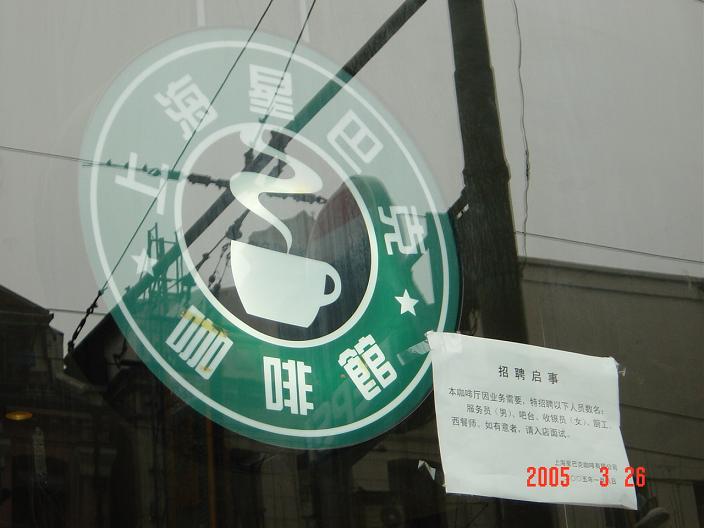
Starbucks Corp. comes out victorious in the trademark related law suit against Shanghai Xingbake Cafe that started December 2004 and ended on the last day of 2005. Shanghai No. 2 Intermediate People's Court ruled that Xingbake has conducted illegal competition by using the name Xingbake 星巴克,the name Starbucks is using in China. Xing means star in Mandarin and the characters ba and ke sound together a bit like bucks.

Shanghai Xingbake Cafe has to pay 500,000 yuan (US$61,728) to Starbucks Corporation and a make a public apology in the Xinmin Evening News.

"According to the judges it is the first verdict that local courts have made on infringement of a famous international trademark since the revised Trademark Law was enacted on December 1, 2001." (revised on October 27th 2001)

The Amended Law explicitly provides protection for foreign famous marks. A mark copying, imitating or translating an unregistered foreign famous mark on identical or similar goods or services with likelihood to cause confusion will not be granted registration or will be prohibited from being used. Source: Wang & Wang. More here.

Xingbake used the name of Xingbake earlier than the Chinese trademark of Starbucks was registered. If this were the case, before December 1, 2001, the revised Trademark law is working retroactively. If the name was registered after December 1, 2001, it should not have been granted refistration.

"The Nanjing Road branch of Xingbake also used a green logo similar to that of Starbucks on its menus, receipts and name cards. It has a picture of a coffee cup in the circle, instead of a mermaid, however. "This will mislead consumers to think Xingbake is related to Starbucks and harm the reputation of the Starbucks trademark," said Fu Qiangguo, the attorney for Starbucks ."

Read more here.
continue reading ...